


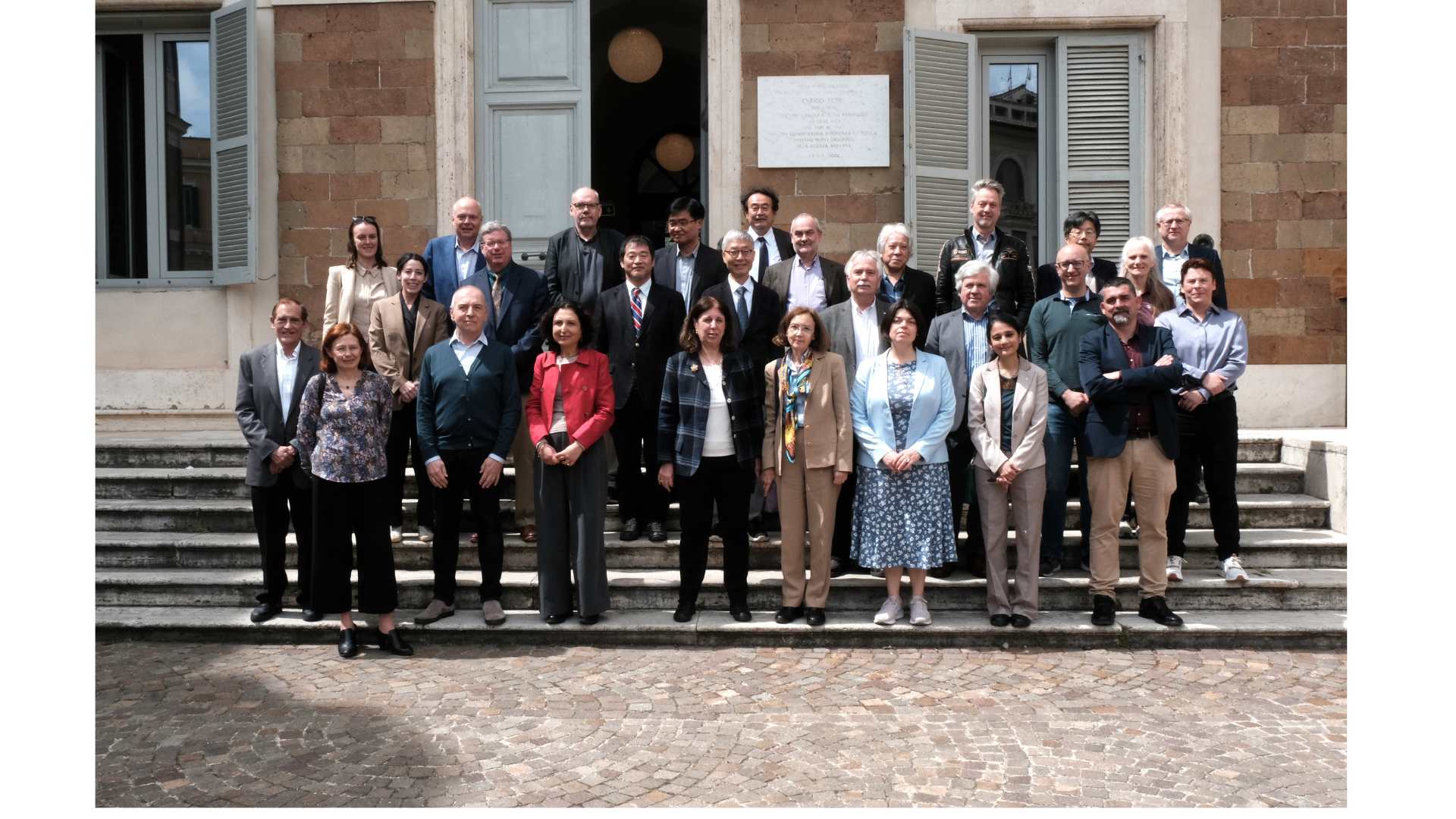
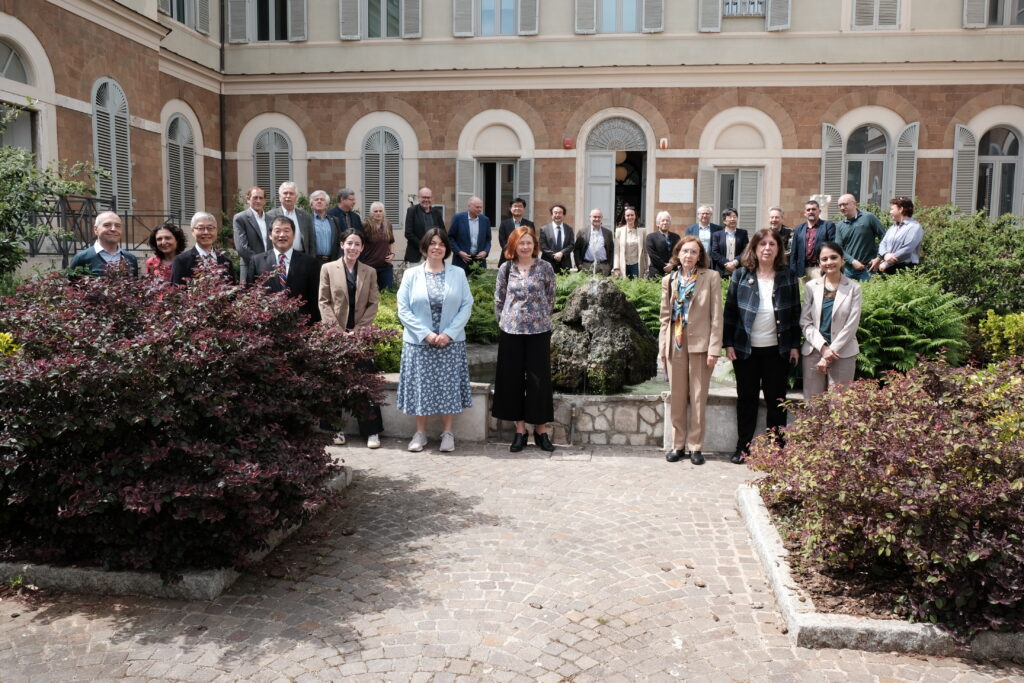
Rome, April 22, 2026. On April 15-16, 2026, the Centro Ricerche Enrico Fermi (CREF) hosted the annual meeting of the Commission C12 of the International Union of Pure and Applied Physics (C12-IUPAP) and Working Group 9 (WG9). This vital gathering brings together researchers in Nuclear Physics to discuss and coordinate international cooperations, continuing a century-long legacy of global scientific collaboration. The status of existing and planned major infrastructure worldwide, primarily devoted to nuclear physics research, was presented.
C12 of IUPAP and WG9: Two Decades of Scientific Coordination
The IUPAP was established in Brussels in 1922 by 13 founding member countries to foster international collaboration in physics across all disciplines. Since its inception under its first President, Nobel Laureate Sir William Henry Bragg, and its first Secretary, Henri Abraham, the Union has been instrumental in uniting the global physics community. The first commission, dedicated to symbols and units, was created in 1931, while C12 was established by IUPAP in 1960 to promote the exchange of information and views among members of the international nuclear physics community.
Building on this profound legacy, Working Group 9 (then chaired by Angela Bracco) was established in 2003, specifically dedicated to the International Cooperation in Nuclear Physics (ICNP). Formed upon the recommendation of the IUPAP Commission on Nuclear Physics (C12), WG9 was given a comprehensive mandate to evaluate and guide the key issues facing Nuclear Physics worldwide, including producing and maintaining a comprehensive compendium of operating and future nuclear facilities worldwide, exploring mechanisms to enhance international cooperation, and serving as a source of expert advice for governmental and intergovernmental organisations.
As WG9 convened at CREF this April, the agenda focused on action items to advance these foundational mandates while addressing new challenges in the field. The C12 (chaired by Maria J.C. Borge, Madrid) actively supports WG9’s efforts and held a parallel closed session during the meeting.
On the first day, news from various nuclear physics facilities was presented, and the second day was devoted to a symposium on emerging topics in basic nuclear science and applications. Experts from three continents delivered very informative presentations. An in-camera meeting with representatives of funding agencies, organised by Diego Bettoni (INFN, Ferrara), was also held on this second day.
NuPECCMeeting
April 17 has been dedicated to the NuPECC (Nuclear Physics European Collaboration Committee) meeting, aiming to strengthen nuclear science in Europe by promoting collaboration, developing strategic plans, and advising funding agencies. In a well-attended meeting, NuPECC listened to and discussed the usual updates on the ESFRI Facilities, in particular FAIR, and the international partner committees in the US, Asia, and Latin America. The implications of the ESPPU for nuclear physics activities at CERN were examined, as were those of the rather recently formed committee for early career researchers, NuFFER. New members for the Board of Directors of ECT*, Trento, were approved, and changes in the Editorial Board of Nuclear Physics News were decided. Emphasis was also placed on the announced initiatives of the European Commission for 2026 and 2027, and on building consensus among all the Research Infrastructures of the ESFRI PSE. All activities of NuPECC are comprehensively covered on its website: https://www.nupecc.org.
Connecting with the Origins of Nuclear Physics: The Enrico Fermi Museum
Beyond the formal sessions and strategic discussions, participants expressed profound appreciation for the opportunity to visit the Enrico Fermi Museum, located on the historic grounds of the Regio Istituto di Fisica, where Fermi worked. For the visiting physicists, the museum represented a pilgrimage to the very origins of their field.
Angela Bracco, president of CREF, Diego Bettoni, member of the executive board of INFN, and Iris Dillmann from TRIUMF (Canada), scientific secretary of WG9, are very grateful to the CREF personnel who have provided great support for the success of these events.