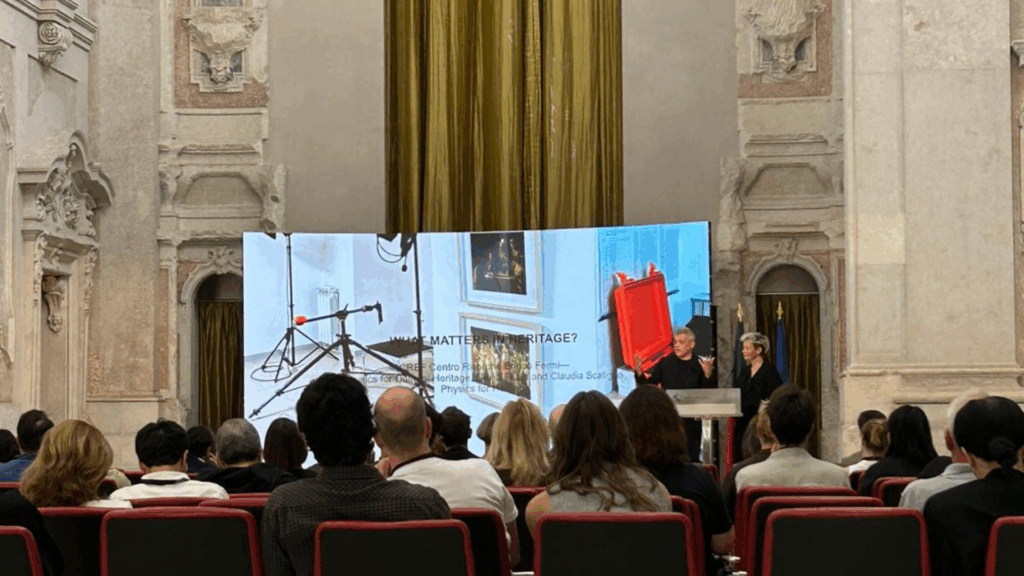
“How heavy is a City?” This question served as the inspiration for the 2025 edition of the Lisbon Architecture Triennale, prompting a profound reflection on the contemporary challenges facing human spaces, at a time when the city can be considered co-extensive with the technosphere. This new emerging planetary paradigm defines the Anthropocene. This perspective was explored through the […]

On October 2, 2025, the Enrico Fermi Research Centre (CREF) will host the first PhD Day of the Italian Association of Archaeometry (AIAr). This event will be dedicated to the work of PhD students specializing in science for cultural heritage, offering a valuable opportunity for exchange and discussion. CREF’s established research line and laboratory in […]

A recent study published in the Journal of Cultural Heritage reveals fascinating insights into the metalworking techniques used in ancient Egypt. Researchers from CREF, CNR-ISPC, INFN, and the Museo Egizio (Turin) joined forces to analyze 12 copper-alloy objects from the undisturbed tomb of Kha and Merit (TT8), dating back to the mid-18th Dynasty (circa 1425-1352 […]

Title: Spectroscopic Benchmarks by Machine Learning as Discriminant Analysis for Unconventional Italian Pictorialism Photography Authors: Claudia Scatigno (Centro Ricerche Enrico Fermi), Lorenzo Teodonio (Centro Ricerche Enrico Fermi), Eugenia Di Rocco (Freelance Restorer – Centro di Ricerca e Archiviazione della Fotografia, Spilimbergo), Giulia Festa (Centro Ricerche Enrico Fermi) Published on Polymers 2024, 16(13), 1850; https://doi.org/10.3390/polym16131850 Abstract […]

A team of Italian researchers – R.C. Ponterio and S. Trusso (CNR-IPCF), G. Festa and C. Scatigno (Enrico Fermi Research Center), G. Romanelli (University of Tor Vergata), A. Piperno (University of Messina). – has tested a miniaturized device grown by Surface-Enhanced Raman Spectroscopy with VESUVIO, a technique that could be an important tool for nuclear […]

Title: Neutron sensing at spallation neutron sources by SERS Authors: Sebastiano Trusso (Istituto per i Processi Chimico-Fisici, CNR, Messina), Giulia Festa (Centro Ricerche Enrico Fermi, Roma, Italy), Claudia Scatigno (Centro Ricerche Enrico Fermi, Roma), Giovanni Romanelli (Dipartimento di Fisica & NAST Centre, Università degli Studi di Roma “Tor Vergata”), Anna Piperno (Department of Chemical, Biological, […]

SLOW SUMER. Repair, Reuse, Recycling and Southern Mesopotamian Society in the Changing World of 2500-2000 BC Principal Investigator: Licia Romano (Sapienza Università di Roma) Vice Principal Investigator: Giulia Festa (CREF) CREF Team: Giulia Festa, Claudia Scatigno, Silvia Giampaolo, Valentina Caruso Code: 2022LFKPNH SLOW SUMER aims to study the Repair, Reuse, and Recycling in the framework of […]

Uno studio pubblicato su Scientific Reports di Nature aggiunge importanti elementi alla comprensione dei riti funerari della Roma imperiale, grazie all’analisi combinata di spettroscopie vibrazionali su resti ossei ritrovati nell’Ipogeo delle Ghirlande, a Grottaferrata (Roma). Lo studio è stato condotto dal CREF, dal Servizio di Antropologia del MIC, dai ricercatori dell’STFC Rutherford Appleton Laboratory e […]
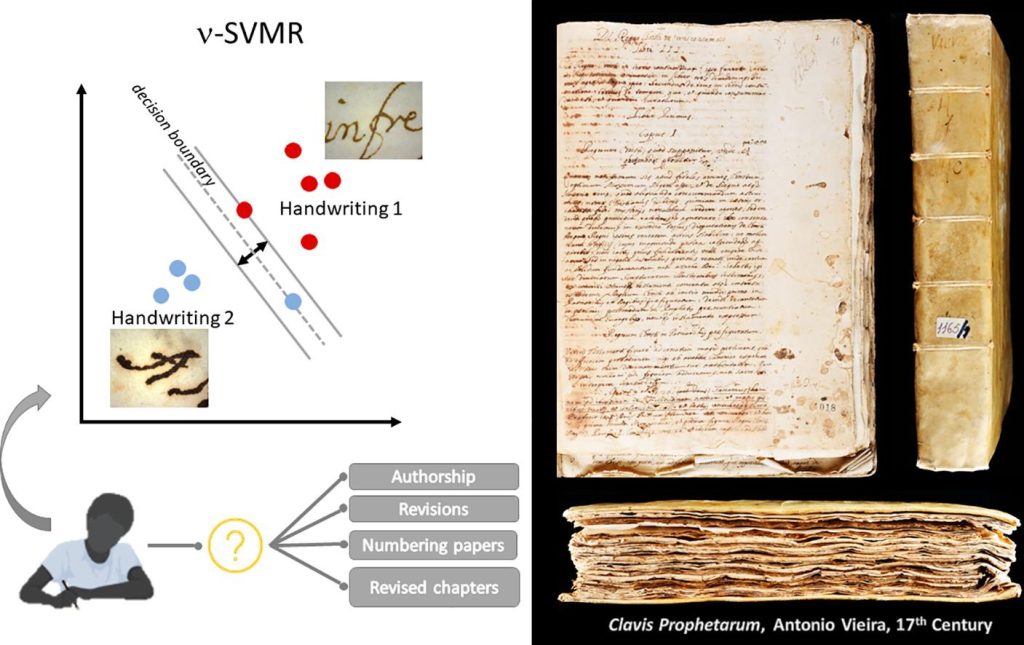
Researchers from CREF and the Historical Archive of the Pontifical Gregorian University used a novel approach that combines machine learning and spectroscopic techniques to understand the genesis of an ancient book via handwriting attribution. The study, published in “Expert System with Applications“, analyzed Clavis Prophetarum, a manuscript by Antonio Vieira, one of the founding fathers […]

the research The Physics for Cultural Heritage project addresses archaeological, artistic, and conservation issues by developing new analytical methods based on material characterization and Machine Learning. The objective is to contribute to the study of composite materials of historical and artistic importance by developing new methodologies for identifying microscopic benchmarks in relation to their archaeological, […]