





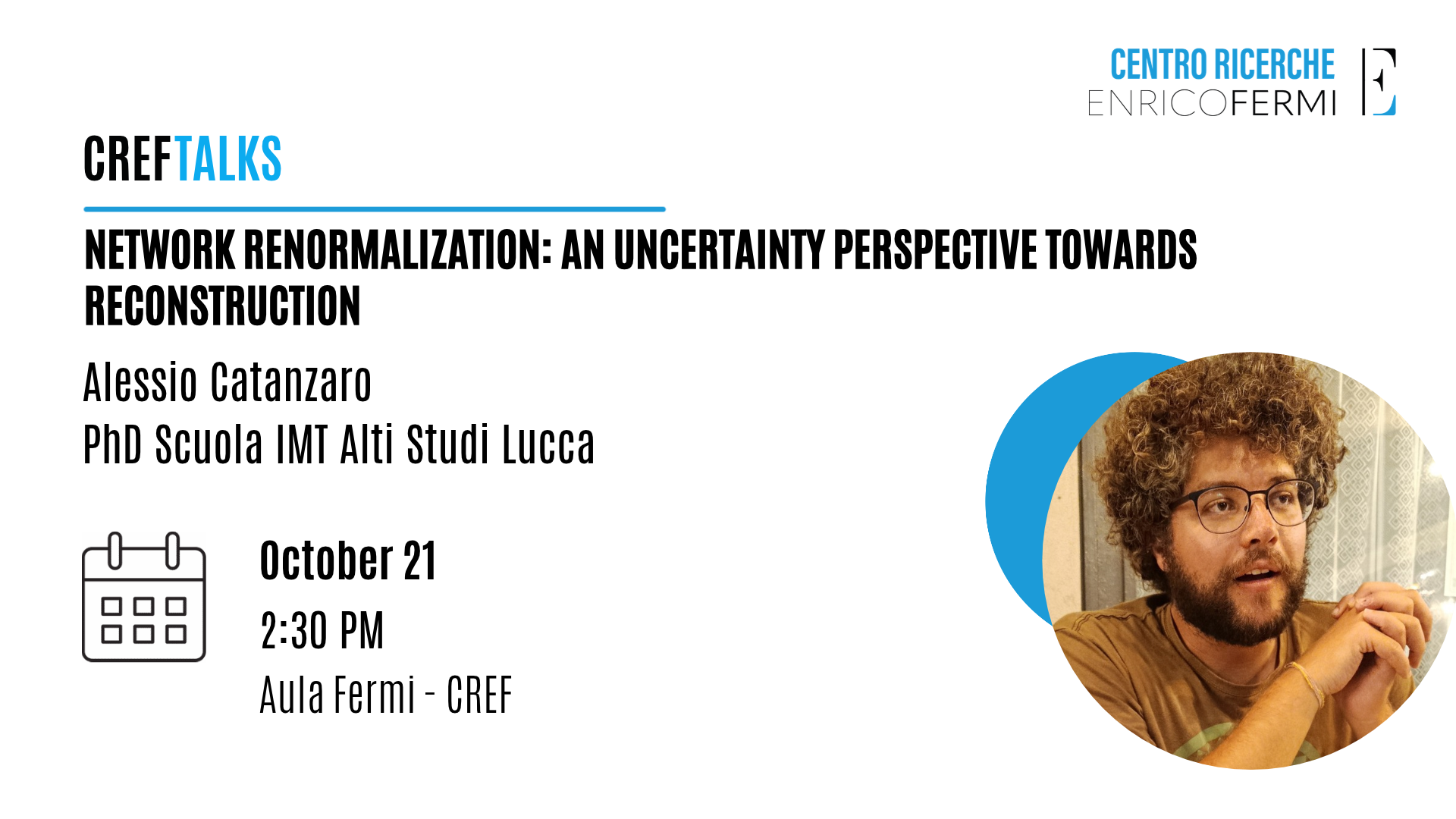
Wednesday, October 21
2:30 pm
CREFTalk
Title:
Network renormalization: an uncertainty perspective towards reconstruction
Abstract:
What happens to a network model when you can’t see all of it? In this talk, I approach the problem of network coarse-graining from an unfamiliar angle: not through geometry or dynamics, but through uncertainty.
Starting from a general Exponential Random Graph (ERG) framework, I derive exact relations governing how effective Hamiltonians transform when a subset of links is hidden or unobserved. Rather than grouping nodes by spatial proximity or diffusion, the renormalization here is driven by marginalization: integrating out uncertainty over unobserved structure.
A central finding is that this process is generically non-closed: marginalizing over missing links induces higher-order effective interactions, meaning that simple random graph models do not stay simple under renormalization. This lack of closure, rather than being a nuisance, turns out to carry useful information.
In the second part of the talk, I show how this non-closure can be turned into a tool for inference and reconstruction. By fitting an effective model to observable data and exploiting the derived renormalization relations, one can set up inverse problems to recover the microscopic Hamiltonian parameters underlying the full, partially hidden network.
Speaker:
Alessio Catanzaro – PhD Scuola IMT Alti Studi Lucca