
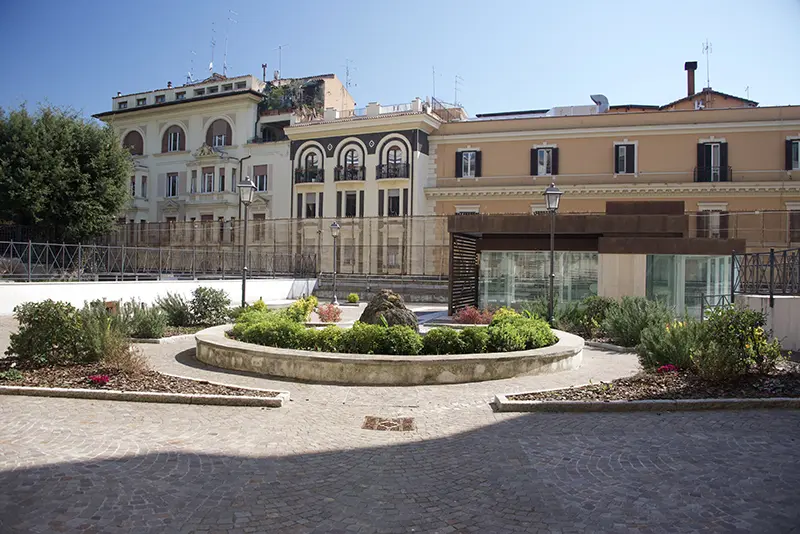
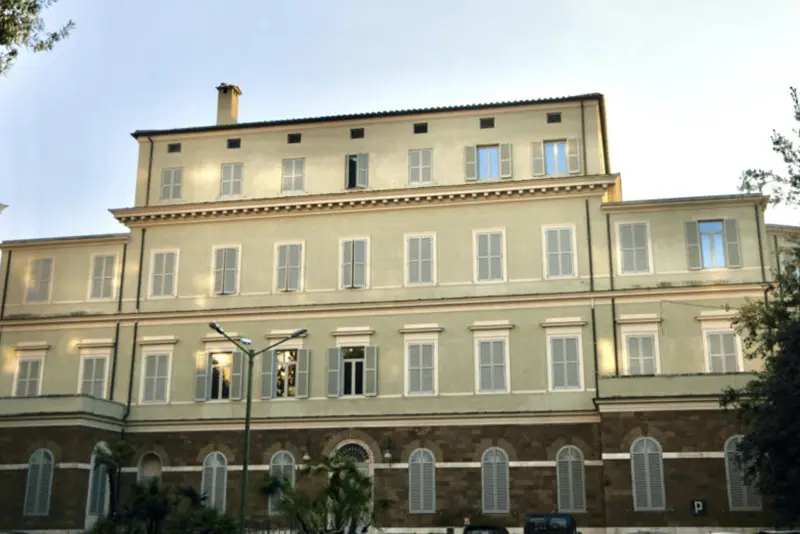
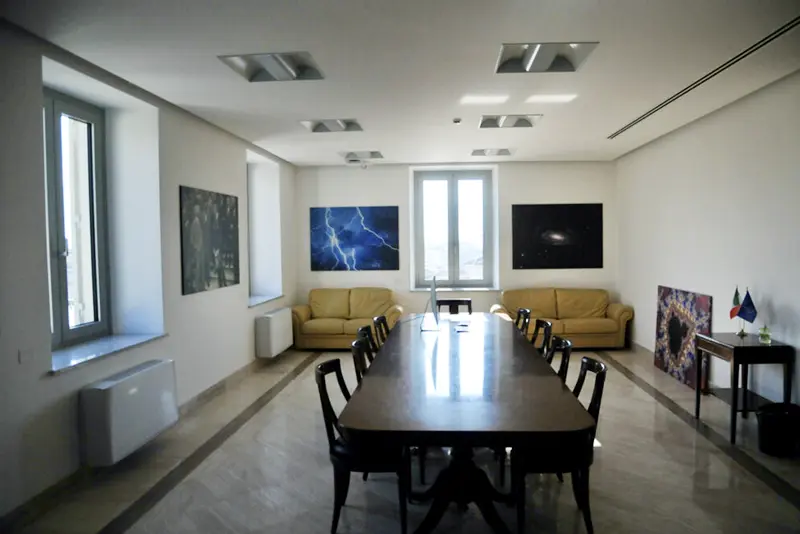

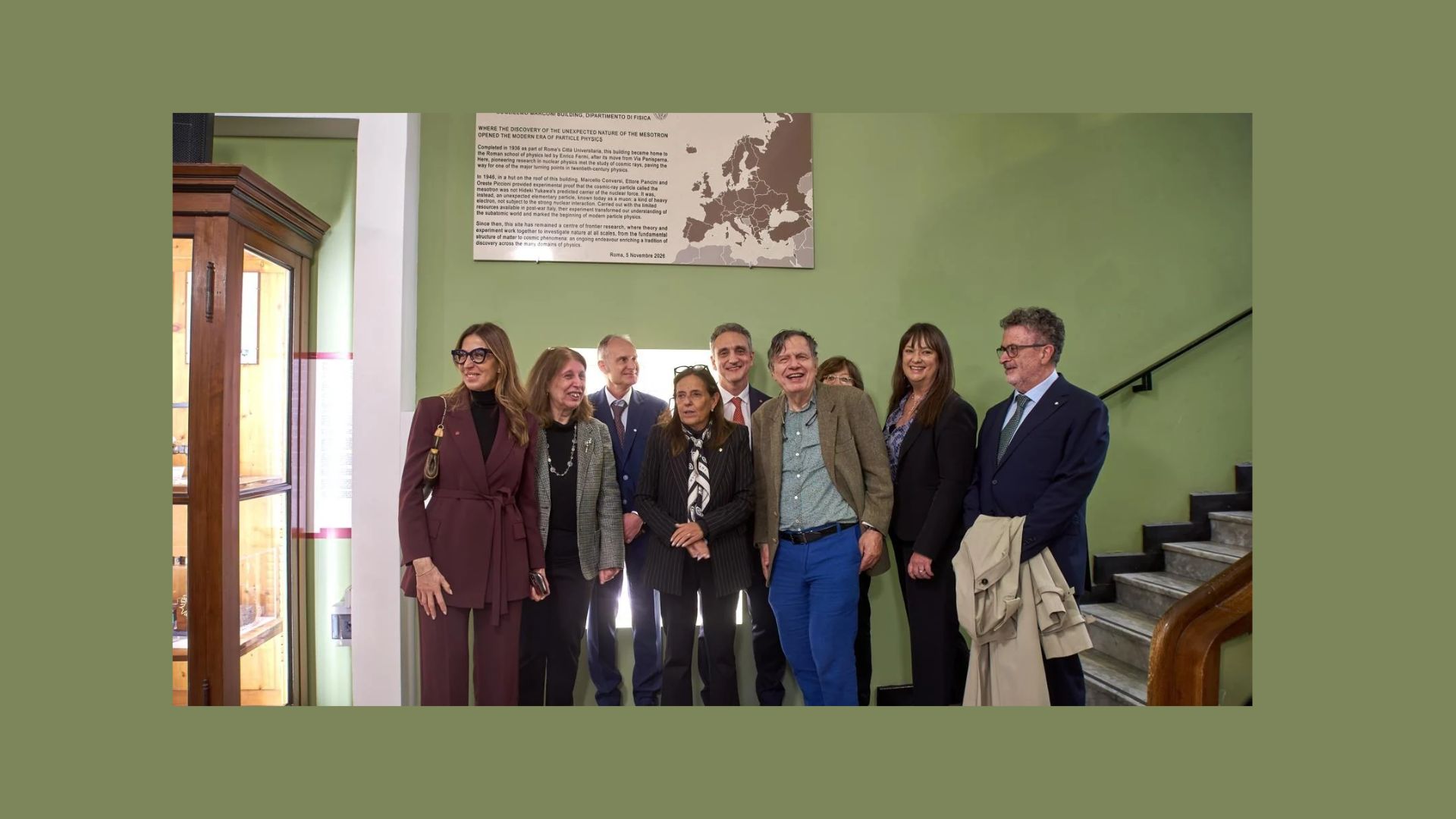

With the ceremony held on 5 November at Sapienza University of Rome, the Guglielmo Marconi Building officially became one of the European Physical Society (EPS) Historic Sites. This recognition celebrates one of the landmark locations of twentieth-century physics and, for the Enrico Fermi Research Center (CREF) and the Enrico Fermi Museum, carries special significance as it forms part of a broader scientific narrative that symbolically connects Via Panisperna to the groundbreaking experiment of Conversi, Pancini, and Piccioni.
The EPS plaque commemorates the experiment carried out in 1946 by Marcello Conversi, Ettore Pancini, and Oreste Piccioni, widely regarded as one of the foundational milestones of modern particle physics. Working with limited resources in post-war Italy, the three young researchers demonstrated that the “mesotron” observed in cosmic rays was not the particle predicted by Hideki Yukawa as the mediator of the nuclear force, but something entirely different: the muon. This discovery profoundly transformed our understanding of the subatomic world and, as Nobel laureate Luis Alvarez later recalled, marked the beginning of contemporary particle physics.
The inauguration ceremony was attended by Daniele Del Re, Director of the Department of Physics; Antonella Polimeni, Rector of Sapienza University of Rome; José María de Teresa, President of the European Physical Society; and Angela Bracco, President of CREF, who highlighted the strong historical connection linking the Marconi Building to the scientific heritage preserved at the Enrico Fermi Museum.
“That connection is rooted above all in people,” said CREF President Angela Bracco. “Marcello Conversi belonged to the Roman school of physics that developed around Enrico Fermi, under whom he studied at the University of Rome. The discovery celebrated by this new EPS plaque therefore represents one of the most significant developments of the scientific legacy left by Fermi and his collaborators, demonstrating how the tradition of excellence established during the Via Panisperna years continued to produce revolutionary results in the post-war period.”
The occasion was marked by a workshop entitled “The Marconi Building: Living Physics History. From the Conversi-Pancini-Piccioni Experiment to New Research Frontiers.” Focused on historical continuity and the transfer of knowledge between generations, the event featured lectures, discussions, and a highly successful photographic competition. The workshop concluded on 6 November with a visit by a delegation of approximately forty participants to the Enrico Fermi Museum, offering them the opportunity to retrace the origins of the Roman school of physics and explore the places where some of the twentieth century’s most important scientific discoveries were made.
Among the visitors were the sons of Marcello Conversi and Oreste Piccioni, adding particular symbolic value to an event that brought together members of the international scientific community and the families of the protagonists of an extraordinary era in scientific research.
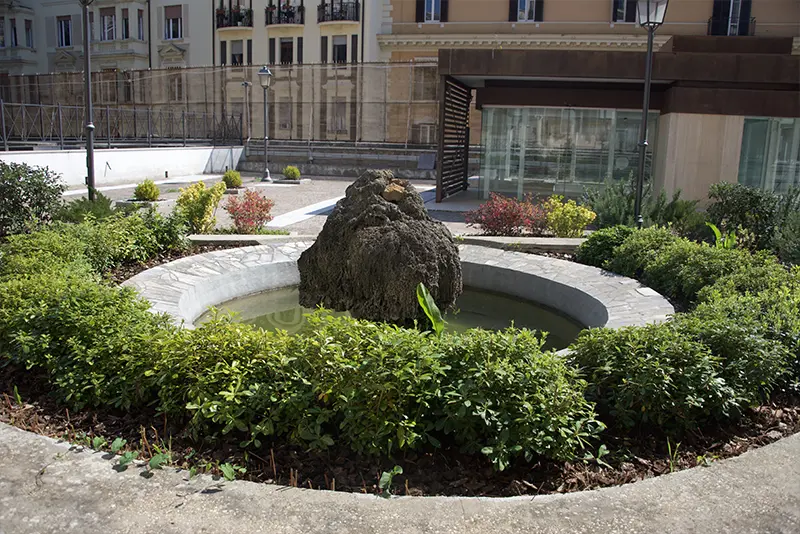
The visit also highlighted another important connection between the two sites. The Enrico Fermi Museum hosts the EPS plaque dedicated to the Goldfish Fountain (Fontana dei Pesci Rossi), the first site in Rome to receive Historic Site recognition from the European Physical Society.
Today, with the recognition of the Marconi Building, Rome can count on two EPS Historic Sites that represent different yet deeply interconnected chapters of the same scientific story. On one side stands the Goldfish Fountain, symbol of the Via Panisperna group and of the research led by Enrico Fermi; on the other, the building associated with Marcello Conversi, a student of that school, who together with Pancini and Piccioni made a discovery that opened a new era in the study of elementary particles.
Two plaques, two places, one story: the story of the remarkable continuity of Roman physics, capable of passing on knowledge, ideas, and scientific passion from one generation to the next.