
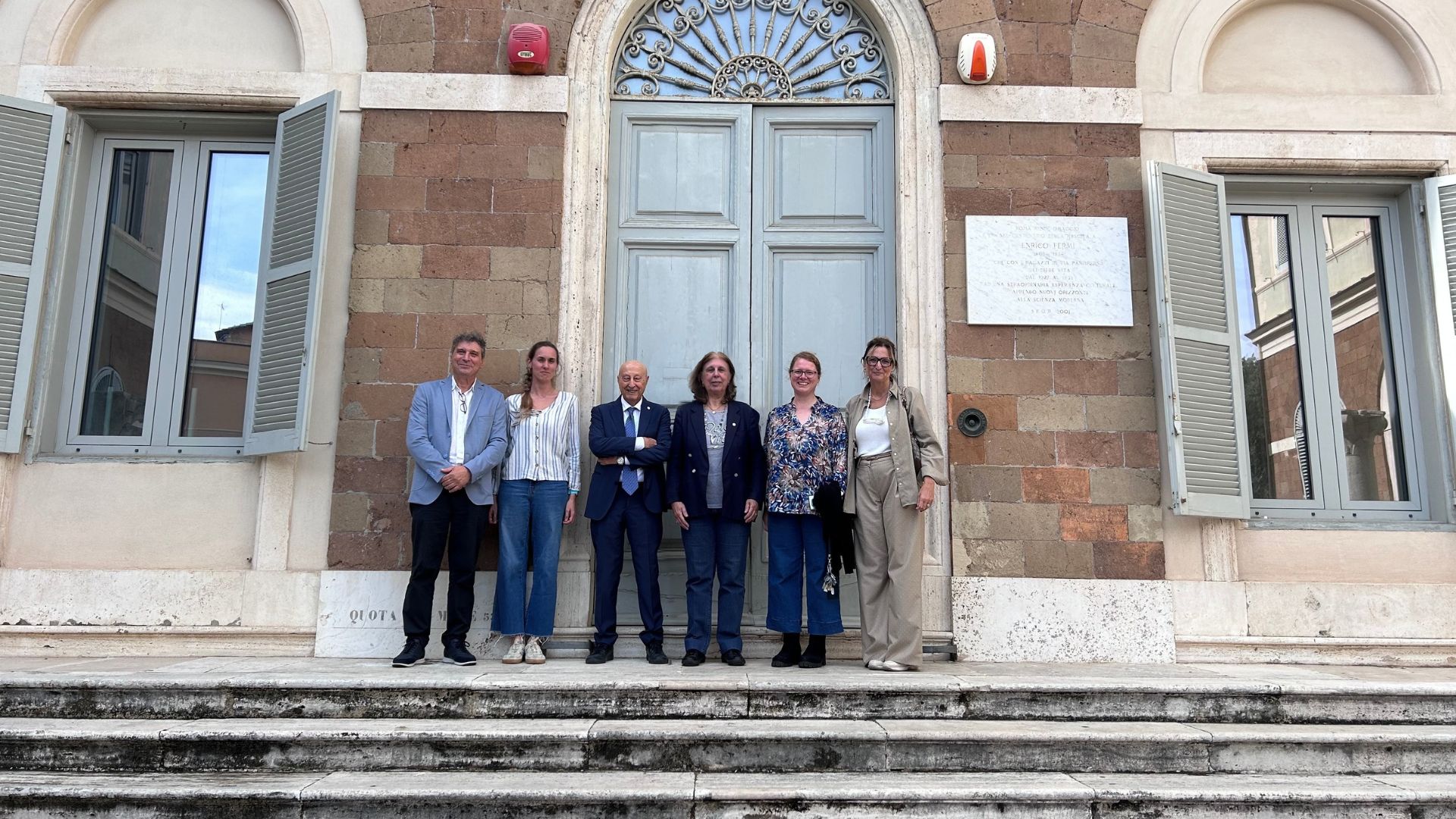
The Enrico Fermi Research Centre welcomed a delegation from the Istituto Lombardo Academy of Sciences...

The Enrico Fermi Research Center - CREF promotes original and high-impact lines of research, based on physical methods, but with a strong interdisciplinary character and in relation to the main problems of the modern knowledge society.
The CREF was born with a dual soul: a research centre and a historical museum. Its aim is to preserve and disseminate the memory of Enrico Fermi and to promote the dissemination and communication of scientific culture.
Publications, news, press review. For interviews, filming, and press contacts, please write to comunicazione@cref.it
The project focuses on the research conducted in Rome by those physicists who, despite frequenting the Physics Institute of Rome, were not part of the inner circle of the “Ragazzi” (Boys) gathered around the figure of Enrico Fermi, or who, despite being part of it, were in Rome for a very limited period of time, such as, in particular, Aldo Pontremoli, Bruno Pontecorvo, and Oscar D’Agostino. In continuity with the past, the project will be based on primary sources provided by original scientific literature and archival documents.
Furthermore, on the occasion of the bicentenary of the death of Alessandro Volta (1827), the project will examine in depth the role played by the Foundation named after him, annexed to the R. Accademia d’Italia (Royal Academy of Italy), in fostering the development of modern physics in Italy during the 1920s and 1930s through the organization of international congresses and the funding of research fellowships abroad.
As is well known, the colloquial expression “Via Panisperna Boys” (Ragazzi di Via Panisperna) usually refers to the group of young physicists who gathered in the early 1930s at the Institute of Physics of the Royal University of Rome in Via Panisperna, around the figure of Enrico Fermi. At times, they have also been defined as “Senator Corbino’s Boys”—in particular by Laura Fermi in 1954. In fact, Orso Mario Corbino was the Director of the Institute in the early 1930s and was highly interested in the strategic developments of research. The recognized leader of the “Boys” was, of course, Fermi himself. The other prominent figures were Edoardo Amaldi, Oscar D’Agostino, Bruno Pontecorvo, Franco Rasetti, Emilio Segrè and, at a slightly different level of closeness, Ettore Majorana.
The scientific rationale of this project is the study of the reasons that led to the dissolution of the group in 1935, with special reference to the scientific fate of D’Agostino and Pontecorvo. It also intends to broaden the scope regarding the key figures, namely by delving into the contributions of physicists who, like Aldo Pontremoli, frequented the Physics Institute of Rome but were not part of the group of the “Boys”. In continuity with the past, these historiographical researches will be based on primary sources provided by original scientific literature and archival documents.
An integral part of the project will be the study of the role played by the Foundation named after Volta, annexed to the R. Accademia d’Italia, in fostering the development of modern physics in Italy through the organization of international congresses (such as the famous “International Congress of Physicists” of 1927) and the funding of research fellowships abroad.
Nadia Robotti (Department of Physics, University of Genoa)
Matteo Leone (Department of Philosophy and Education Sciences, University of Turin)
Francesca Monti (Department of Computer Science, University of Verona)
Emanuela Colombi (State Historical Society for the Parma Provinces)