


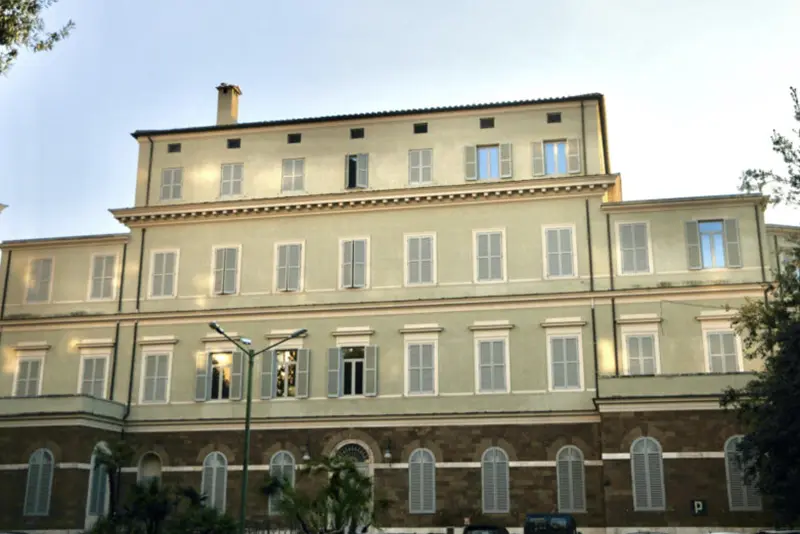

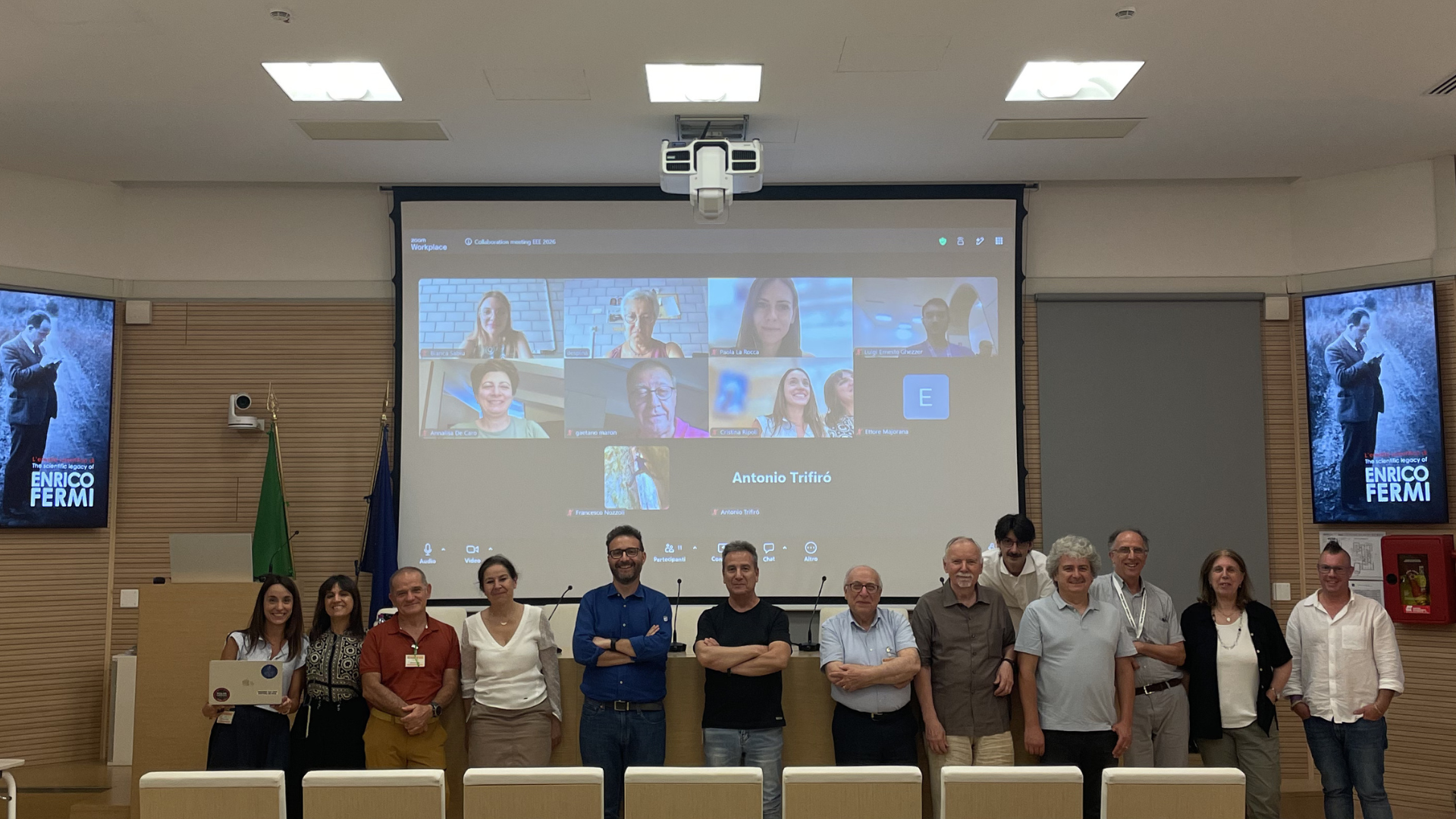
On June 30 and July 1, 2026, the Enrico Fermi Research Center (CREF) hosted the meeting of the EEE Collaboration...

The Enrico Fermi Research Center - CREF promotes original and high-impact lines of research, based on physical methods, but with a strong interdisciplinary character and in relation to the main problems of the modern knowledge society.
The CREF was born with a dual soul: a research centre and a historical museum. Its aim is to preserve and disseminate the memory of Enrico Fermi and to promote the dissemination and communication of scientific culture.
Publications, news, press review. For interviews, filming, and press contacts, please write to comunicazione@cref.it
In the course of 2025, our research activity was structured around two main lines of investigation: (i) the kinematics and dynamics of the Milky Way and several irregular external galaxies; (ii) the study of the large-scale structure of the universe. Regarding the first area, we analyzed the kinematics of the Milky Way outside the galactic plane, obtaining new insights into the geometry of the mass distribution. In addition, we developed a novel method to determine two-dimensional velocity fields and disk deformations in external galaxies, applying it successfully to derive new constraints on their internal dynamics. In the second area, we focused on developing a new statistical method to quantitatively analyze anisotropies in the large-scale mass distribution. This approach was applied with promising results to the analysis of cosmological N-body simulations.
The Cold Dark Matter (CDM) model, the dominant framework in cosmology, posits that 95% of the universe’s matter consists of dark components that can only be detected indirectly, primarily through their gravitational effects. These effects include galactic kinematics, gravitational lensing, and the large-scale geometry of the universe. Within this model, approximately 25% of the universe’s matter is hypothesized to be non-baryonic dark matter (DM), about 70% consists of a repulsive form of energy known as dark energy (DE), and only around 5% is ordinary baryonic matter (BM).
In particular, the model predicts that DM and luminous BM exhibit distinct kinematic and dynamic properties, meaning that observations of luminous matter cannot directly constrain those of dark matter. Despite decades of research, no direct evidence of the existence of non-baryonic DM has been found. Its hypothesized physical properties have been fine-tuned a posteriori to ensure concordance between observations and the model’s theoretical predictions. As for DE, a direct measurement of its existence remains impossible. We do not intend to propose a new theory that, like standard approaches, attempts to explain observations across a vast range of spatial scales—from dwarf galaxies (≈1–10 kpc) to the largest observable structures (≈100–1000 Mpc). Instead, we hypothesize that the mystery surrounding DM lies not only in the immense quantities required, but also in the assumption that a single theoretical framework for DM must necessarily be suited to explain diverse physical processes across spatial scales spanning 5 to 6 orders of magnitude. Indeed, a fundamental assumption of CDM models is that DM behaves identically on both galactic and cosmological scales, establishing a strong physical connection between local and large-scale phenomena. Our goal is to explore whether it is possible to develop a theoretical framework that treats DM-related effects differently depending on the spatial scales, thereby decoupling galactic dynamics from cosmological structures.
Francesco Sylos Labini (Project Leader)