


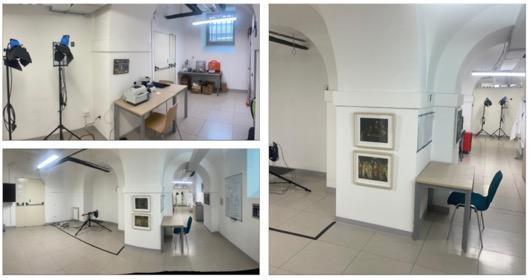
The CREF Physics Laboratory for Cultural Heritage is dedicated to the study of materials of historical and artistic interest through non-invasive and non-destructive analytical techniques and is located on the basement level (-1) of the building. It is currently equipped with instrumentation for X-ray fluorescence spectroscopy (XRaman, XGlab-Bruker), Raman spectroscopy (XRaman, XGlab-Bruker), Fourier-transform infrared spectroscopy (FTIR Nicolet iS5 Conservat-IR, Thermo Fisher Scientific), and hyperspectral imaging (Specim IQ – Konica Minolta). The laboratory also features dedicated high-performance computing workstations for imaging data analysis using specialized software (VGStudio MAX, Volume Graphics), along with ancillary equipment such as an analytical laboratory balance, a desiccator, standard samples, a press, reagents, an oven, a chemical fume hood, and basic laboratory materials.
The laboratory is also stocked with the necessary consumables for conducting experiments. To expand its diagnostic capabilities, the laboratory plans to acquire an X-ray Computed Tomography (CT) imaging system, which will allow for the examination of the internal structure of objects without compromising their integrity. CT will enable the identification of inclusions, cavities, defects, and multilayer structures, offering details inaccessible through other techniques. Furthermore, the collected data will enable the creation of 3D models for advanced analysis through the development of new investigation protocols, as well as for museum enhancement and exhibition. The adoption of this technology will significantly boost the laboratory’s research activities, fostering collaboration with other institutions in the field of study, protection, and enhancement of cultural heritage.
Researchers