


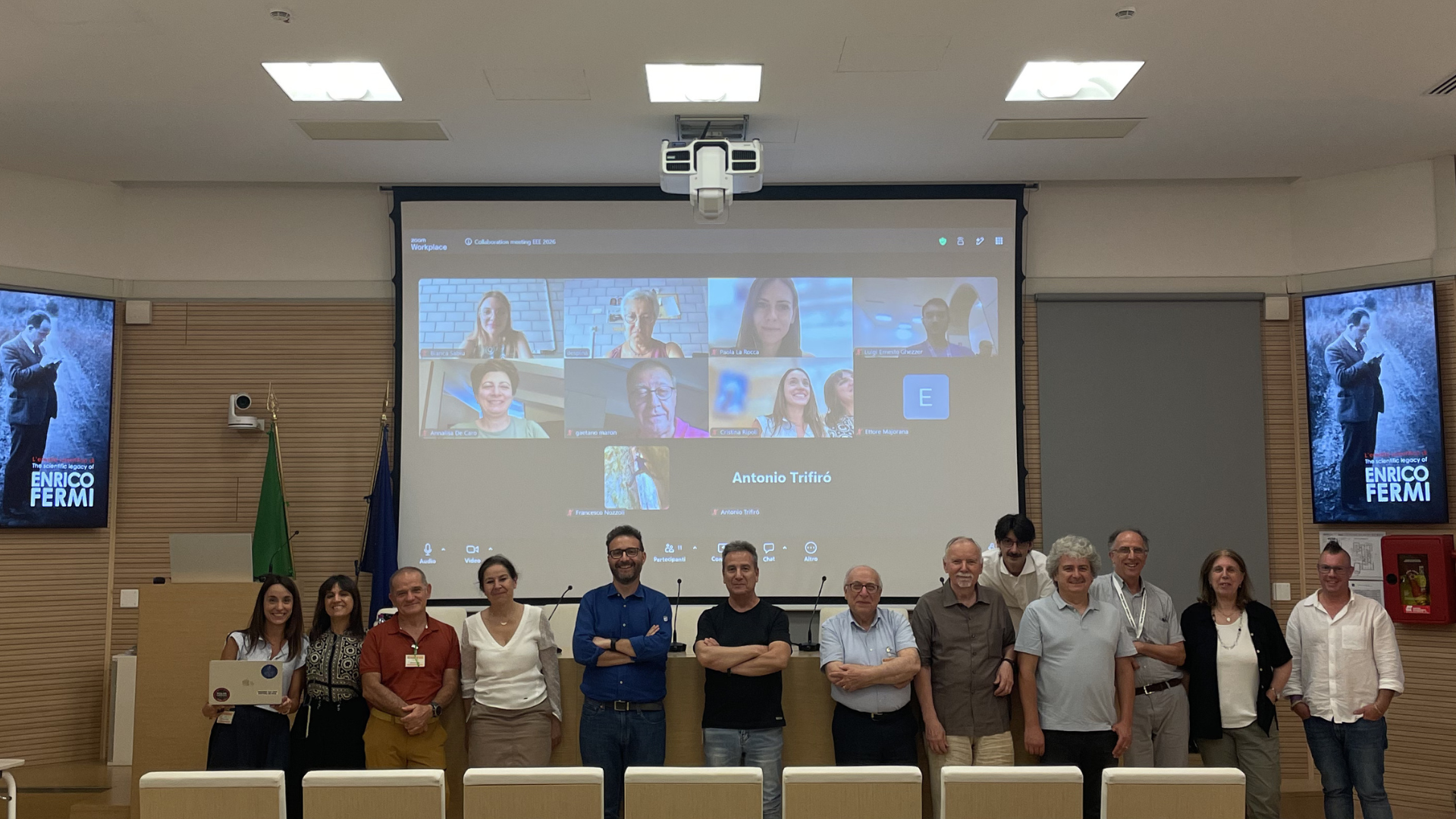
On June 30 and July 1, 2026, the Enrico Fermi Research Center (CREF) hosted the meeting of the EEE Collaboration...

The Enrico Fermi Research Center - CREF promotes original and high-impact lines of research, based on physical methods, but with a strong interdisciplinary character and in relation to the main problems of the modern knowledge society.
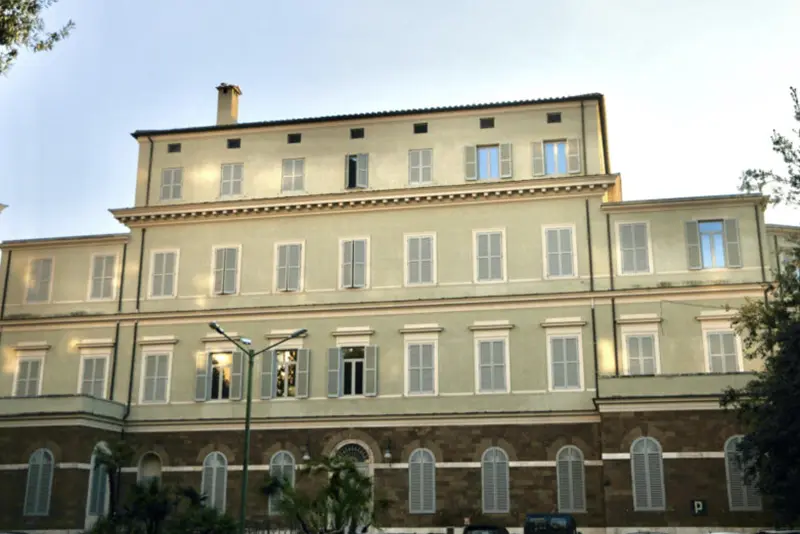
The CREF was born with a dual soul: a research centre and a historical museum. Its aim is to preserve and disseminate the memory of Enrico Fermi and to promote the dissemination and communication of scientific culture.
Publications, news, press review. For interviews, filming, and press contacts, please write to comunicazione@cref.it
Ecco una traduzione professionale, fluida e ottimizzata per il web, che mantiene il tono accademico e scientifico del testo originale:
The Statistical Physics and Complex Systems in Natural Sciences project is structured into closely interconnected lines of research, focused on the multiscale understanding and modeling of natural complex systems. The main directions include:
(i) the development and consolidation of the Laplacian Renormalization Group for the multiscale analysis of heterogeneous complex networks;
(ii) interdisciplinary applications across various fields of the natural sciences;
(iii) the development of advanced techniques in complex systems theory and Reservoir Computing for the analysis of brain activity;
(iv) the use of stochastic models and machine learning tools to study climate dynamics on short time scales.
The project aims to strengthen the role of CREF as an international reference point in developing a geometric description of criticality and scaling phenomena in complex and disordered systems.
Understanding the multiscale organization of complex networks is crucial for analyzing dynamic collective phenomena in fields such as brain functioning, financial crises, and epidemic spreading. Traditional renormalization techniques are ill-suited for generic networks, as they fail to account for local heterogeneity and the microscopic structure of connections. In this context, the Laplacian Renormalization Group (LRG) represents one of the most effective approaches to handle highly heterogeneous networks while preserving local information and multiscale organization.
The project aims to consolidate and extend the LRG toward dynamic universality classes and apply it to biological, ecological networks, and other complex systems. Particular attention will be dedicated to identifying mesoscopic structures and early-warning markers of critical transitions. Recent results also suggest that extended critical phenomena can emerge from purely geometric and topological constraints, indicating that structural organization plays a central role in complex system dynamics. In addition, the project will explore the categorization of graph ensembles and the analysis of artificial neural networks, contributing to the design of modular and robust architectures. Overall, the project helps build a theoretical and applied framework for the multiscale analysis of complex networks, fostering the advancement of knowledge across various scientific domains.