
the organization
research
The Enrico Fermi Research Center - CREF promotes original and high-impact lines of research, based on physical methods, but with a strong interdisciplinary character and in relation to the main problems of the modern knowledge society.
Complexity
Applied Physics
Fundamental Physics
Museum and History of Physics
People
third mission
The CREF was born with a dual soul: a research centre and a historical museum. Its aim is to preserve and disseminate the memory of Enrico Fermi and to promote the dissemination and communication of scientific culture.

news
Publications, news, press review. For interviews, filming, and press contacts, please write to comunicazione@cref.it
2 July 2026
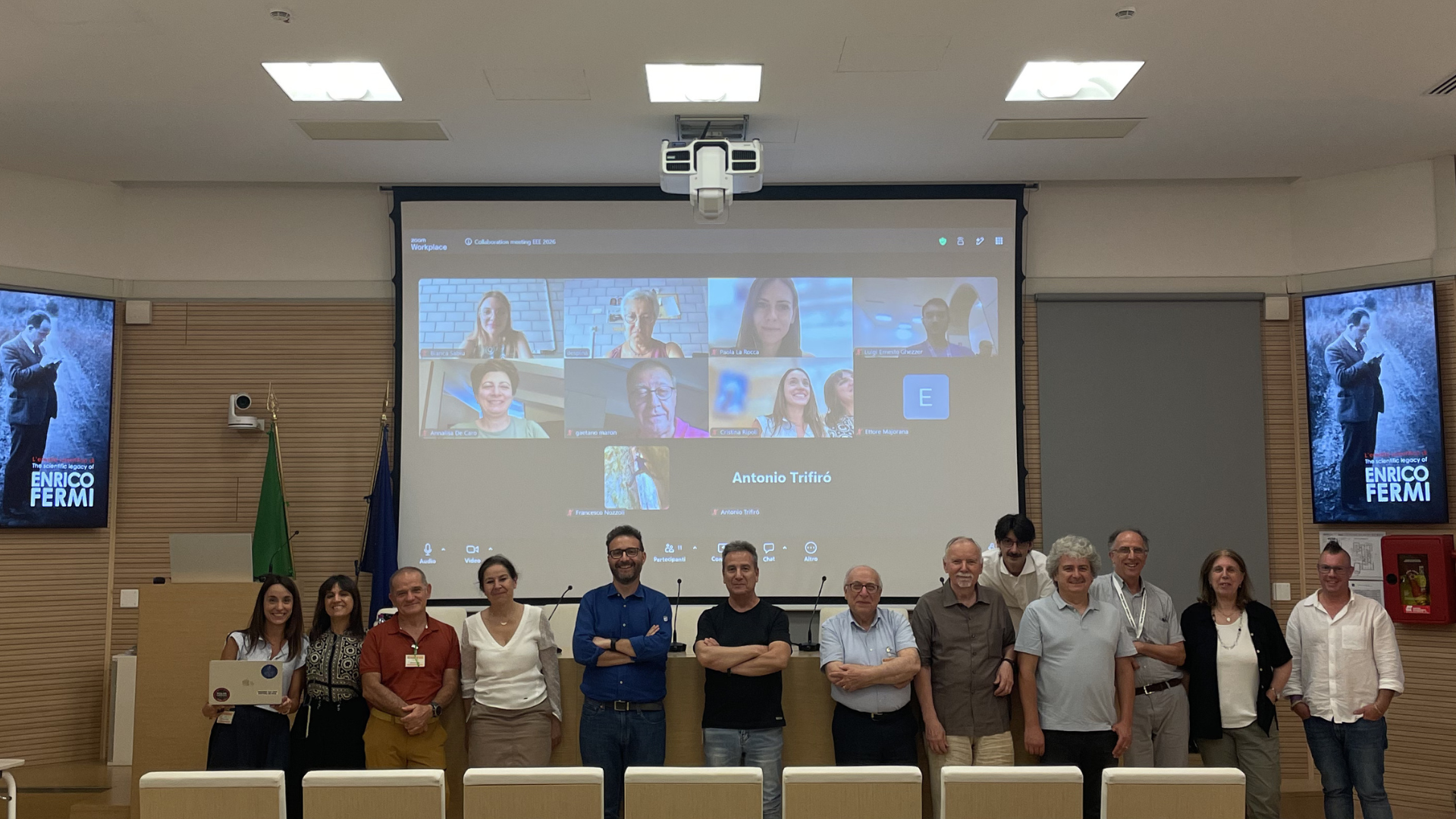
On June 30 and July 1, 2026, the Enrico Fermi Research Center (CREF) hosted the meeting of the EEE Collaboration...
No posts found

the research
Photonic Technologies and Artificial Intelligence
The project aims to develop new photonic systems primarily for the purpose of creating innovative optical computing machines capable of overcoming the limitations of traditional computing machines. The experimental activity explores the use of laser light and its interaction with complex photonic media to accelerate the solution of combinatorial optimization problems and to implement hybrid electronic and photonic neural networks. The theoretical activity is aimed at developing advanced mathematical models for the simulation of combinatorial systems that can be represented as spin systems, with the goal of exploring the classical and quantum physics underlying the devices under study and testing the efficiency of new computing algorithms.
Enrico Fermi was a pioneer in the development and use of calculating machines, examples of which can also be found in the CREF Museum.
In recent years, the concept of a computational machine has broadened considerably, and there is intense activity aimed at devising new computers that include quantum and photonic technologies. Major industrial players worldwide are heavily involved in this direction, including IBM, NTT, HUAWEI, and numerous startups in various technologically advanced countries. The driving force behind new computational technologies is the so-called end of Moore’s law, the empirical rule that over the last two decades has described the rapid growth of computing power in traditional semiconductor systems.
In recent years, the end of this growth has been observed, highlighting a stagnation in performance mainly due to physical limits.
This circumstance has motivated extensive research into new computing technologies. These studies are further fueled by recent findings regarding the environmental impact of new artificial intelligence methods. The algorithms that are now changing society require computing resources that grow exponentially over the years, and their environmental impact can be understood by noting that the training of a single artificial intelligence system produces carbon emissions comparable to those of dozens of intercontinental flights.
It is therefore necessary to develop new technologies that outperform conventional processors and consume less energy: for example, by operating at room temperature without the need for cooling systems.
Photonics is currently regarded as the most promising technology in this context. Studies demonstrate the parallel processing of enormous amounts of data through laser beams that encode information using advanced modulation techniques. In the long term, the inclusion of quantum algorithms may radically accelerate computing speed, as well as enable innovative cryptographic methods.
Photonic and quantum systems can solve optimization problems in polynomial time with respect to the size of the system: a possibility often referred to as “Quantum Advantage.” What CREF aims to pursue through the “Photonic Technologies and Artificial Intelligence” research line is the development of photonic quantum systems for the acceleration of computation, capable of providing the result of the calculation in a robust classical form that is not subject to decoherence and can therefore be immediately interfaced with traditional computers.
The work is carried out along two parallel research lines: an experimental one, centered on the work of CREF’s Computational Photonics Laboratory, headed by Dr. Romolo Savo; and a theoretical one, focused on the development of mathematical models to test the large-scale efficiency of new combinatorial computing algorithms through numerical simulations, headed by Dr. Marcello Calvanese Strinati.