


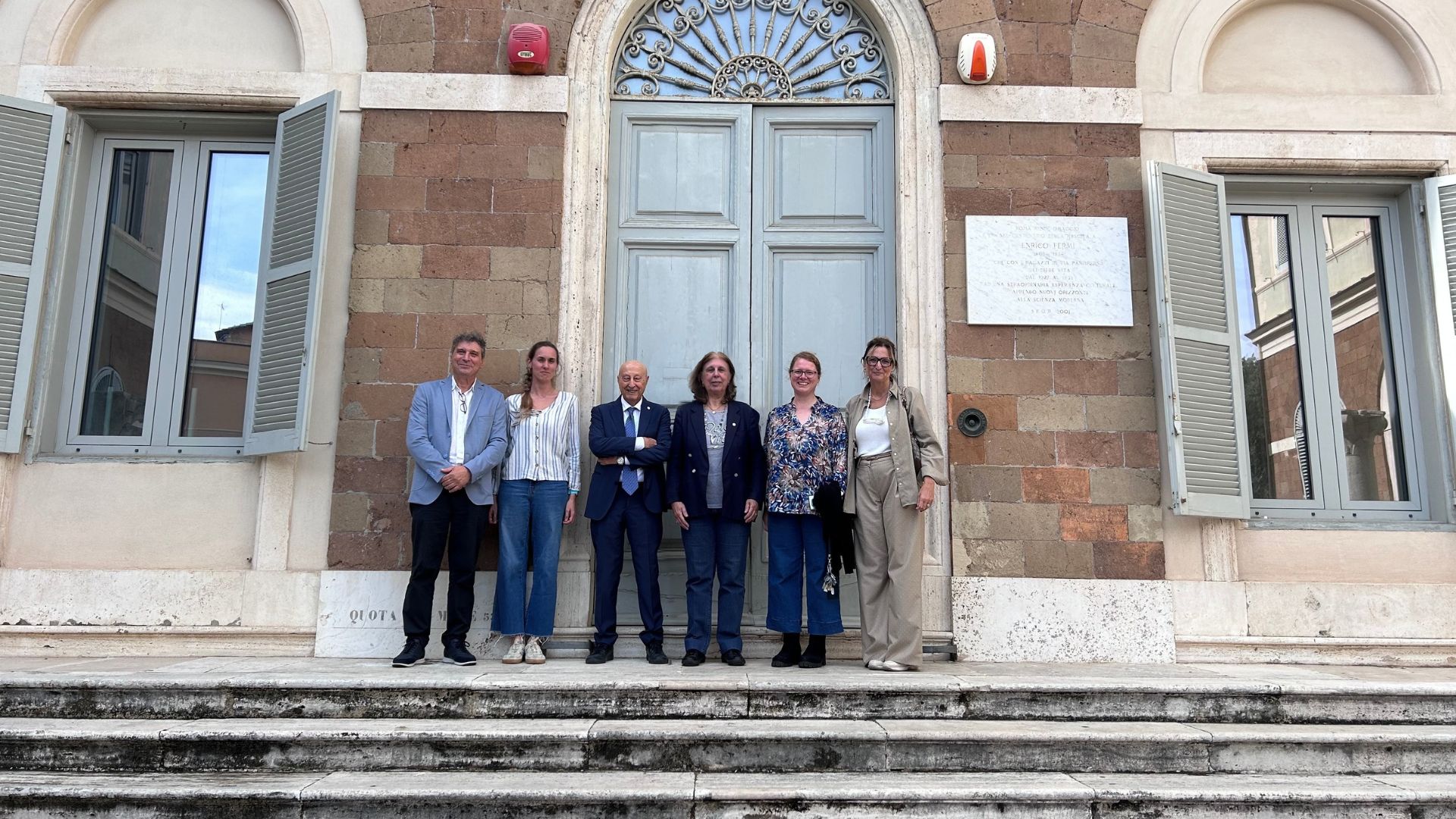
The Enrico Fermi Research Centre welcomed a delegation from the Istituto Lombardo Academy of Sciences...

The Enrico Fermi Research Center - CREF promotes original and high-impact lines of research, based on physical methods, but with a strong interdisciplinary character and in relation to the main problems of the modern knowledge society.
The CREF was born with a dual soul: a research centre and a historical museum. Its aim is to preserve and disseminate the memory of Enrico Fermi and to promote the dissemination and communication of scientific culture.
Publications, news, press review. For interviews, filming, and press contacts, please write to comunicazione@cref.it
Physics, through the theory of complex systems and statistical physics, has provided essential quantitative tools to tackle socio-economic challenges that classical disciplines often fail to interpret. While it is not possible to conduct direct experiments, time series and statistical properties can be analyzed to predict the collective behavior of systems. With this vision in mind, the Social and Economic Complexity project is structured around the following three areas of investigation:
Economic Fitness and Complexity (EFC): A method developed in Rome by Prof. Luciano Pietronero’s group to build data-driven economic models based on Complex Networks and Machine Learning. It has demonstrated the ability to outperform IMF forecasts on country growth and is used by international institutions such as the World Bank and the Joint Research Center (JRC).
Computational Social Science: This field utilizes mobility data, social networks, and digital tracking to study phenomena such as the spread of epidemics, political (mis)information, and group dynamics, integrating physics, mathematics, computer science, and social sciences.
Network Theory Analysis Methods: These methods analyze the structure of complex networks to understand fundamental processes (financial shocks, climate change, and the propagation of diseases and information). Here, null models inspired by statistical physics and information theory are developed to distinguish genuine signals from random fluctuations.
Luciano Pietronero – Ex Professore Ordinario, Sapienza Università di Roma |Referente linea di ricerca