





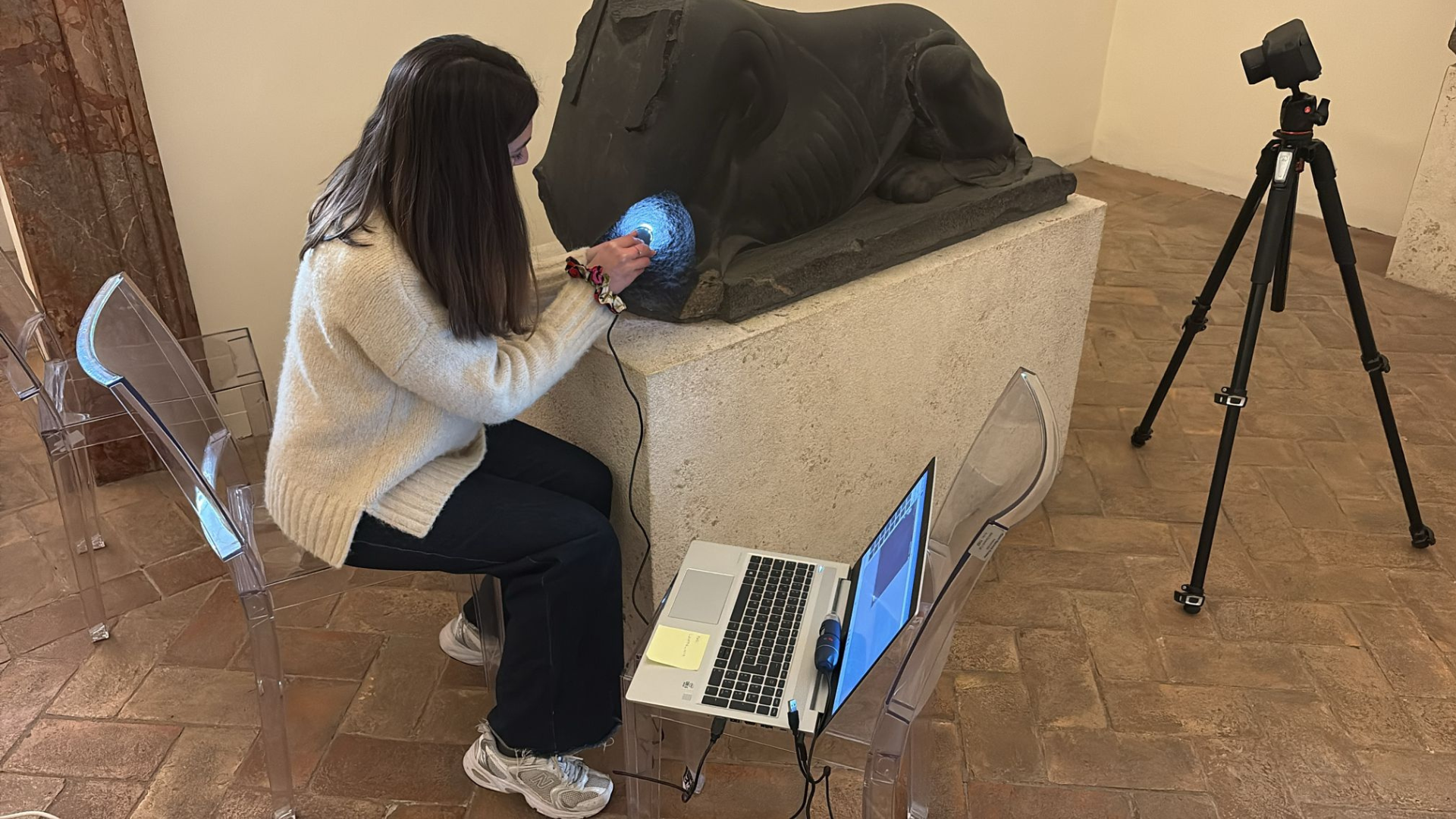
Roma 17 marzo 2026. Un nuovo progetto in collaborazione con il Dottorato in Heritage Science della Sapienza...


The Enrico Fermi Research Center - CREF promotes original and high-impact lines of research, based on physical methods, but with a strong interdisciplinary character and in relation to the main problems of the modern knowledge society.
The CREF was born with a dual soul: a research centre and a historical museum. Its aim is to preserve and disseminate the memory of Enrico Fermi and to promote the dissemination and communication of scientific culture.
Publications, news, press review. For interviews, filming, and press contacts, please write to comunicazione@cref.it
We present a comparison between various algorithms of inference of covariance and precision matrices in small data sets of real vectors of the typical length and dimension of human brain activity time series retrieved by functional magnetic resonance imaging (fMRI). Assuming a Gaussian model underlying the neural activity, the problem is denoising the empirically observed matrices to obtain a better estimator of the (unknown) true precision and covariance matrices. We consider several standard noise-cleaning algorithms and compare them on two types of data sets. The first type consists of synthetic time series sampled from a generative Gaussian model, of which we can vary the fraction of dimensions per sample q and the strength of off-diagonal correlations. The second type consists of a time series of fMRI brain activity of human subjects at rest. The reliability of each algorithm is assessed in terms of test-set likelihood and, in the case of synthetic data, of the distance from the true precision matrix. Based on random matrix theory, we observe that the so-called optimal rotationally invariant estimator leads to a significantly lower distance from the true precision matrix in synthetic data and higher test likelihood in natural fMRI data. We propose a variant of the optimal rotationally invariant estimator in which one of its parameters is optimised by cross-validation. It outperforms all the other estimators in the severe undersampling regime (large q) typical of the fMRI series. We propose a simple algorithm based on an iterative likelihood gradient ascent, leading to very accurate estimations in weakly correlated synthetic data sets.
Read the full article on PHYSICAL REVIEW E 108, 024313 (2023)
Questo sito utilizza i cookie per migliorare la sua esperienza di navigazione. Quelli di natura tecnica sono indispensabili per permettere il corretto funzionamento del sito e sono impostati “attivi” di default.
È possibile proseguire la navigazione, con i soli cookie tecnici, cliccando la “x” in alto a destra ovvero il tasto “nega” presente nel banner. Ciò in quanto il comando switch per attivare o disattivare le altre tipologie di cookie “statistiche” e “marketing” è programmato, per impostazione predefinita, sulla modalità “disattivo”. Solo previo suo consenso, infatti, useremo tali ulteriori tipologie di cookie, anche di terze parti; in particolare, se intende accettarle tutte può cliccare il tasto “accetta” ovvero, se intende accettare solo alcune tipologie, può attivarle, spuntandole, attraverso il tasto “Visualizza le preferenze” e quindi salvare le impostazioni utilizzando il pulsante “Salva preferenze”.
Per maggiori informazioni, la invitiamo a consultare le nostre cookie policy e privacy policy.