

Rome, June 30, 2026 — A study published in the journal Nature by Francesco Sylos Labini (CREF) and Marco...

The Enrico Fermi Research Center - CREF promotes original and high-impact lines of research, based on physical methods, but with a strong interdisciplinary character and in relation to the main problems of the modern knowledge society.
The CREF was born with a dual soul: a research centre and a historical museum. Its aim is to preserve and disseminate the memory of Enrico Fermi and to promote the dissemination and communication of scientific culture.
Publications, news, press review. For interviews, filming, and press contacts, please write to comunicazione@cref.it
Rome, June 30, 2026 — A study published in the journal Nature by Francesco Sylos Labini (CREF) and Marco Galoppo (University of Canterbury, New Zealand) reports the identification of anisotropic structures in the distribution of galaxies on cosmological scales, up to approximately one gigaparsec (billions of light-years).
The result, obtained by analyzing data from the international DESI (Dark Energy Spectroscopic Instrument) project, opens new perspectives in the study of the large-scale structure of the Universe. The analysis is based on a new statistical method, called Angular Distribution of Pairwise Distances (ADPD), which allows the characterization of galaxy distribution by taking into account their mutual orientation. Unlike traditional approaches, which are based on direction-averaged statistics, this method makes it possible to identify any persistent directional structures.
By applying this technique to observational data, the authors detected the presence of anisotropic correlations extending over very large distances, greater than those predicted by standard cosmological models. Indeed, the comparison with numerical simulations based on the ΛCDM model shows that the observed signal is significantly more intense than expected.
The statistical analysis indicates a discrepancy with theoretical predictions exceeding 3σ, which in some configurations surpasses 5σ. Additional verifications, conducted using random catalogs and simulations, suggest that the result is not attributable to systematic effects, the geometry of the sample, or observational distortions.
“These results indicate that the distribution of galaxies could present a greater degree of large-scale anisotropy than predicted by the standard theoretical framework,” states Francesco Sylos Labini. “Further data and analyses will be fundamental to fully understanding the scope of this result.”
If confirmed, this evidence could have implications for the interpretation of the large-scale structure of the Universe and for the cosmological models currently in use. Future extensions of the DESI project and upcoming observational missions, including Euclid, will allow these results to be verified over even larger volumes.
Authors: Sylos Labini, F. & Galoppo, M.
Title: Detection of anisotropic cosmic structures on a gigaparsec scale, Nature (2026)
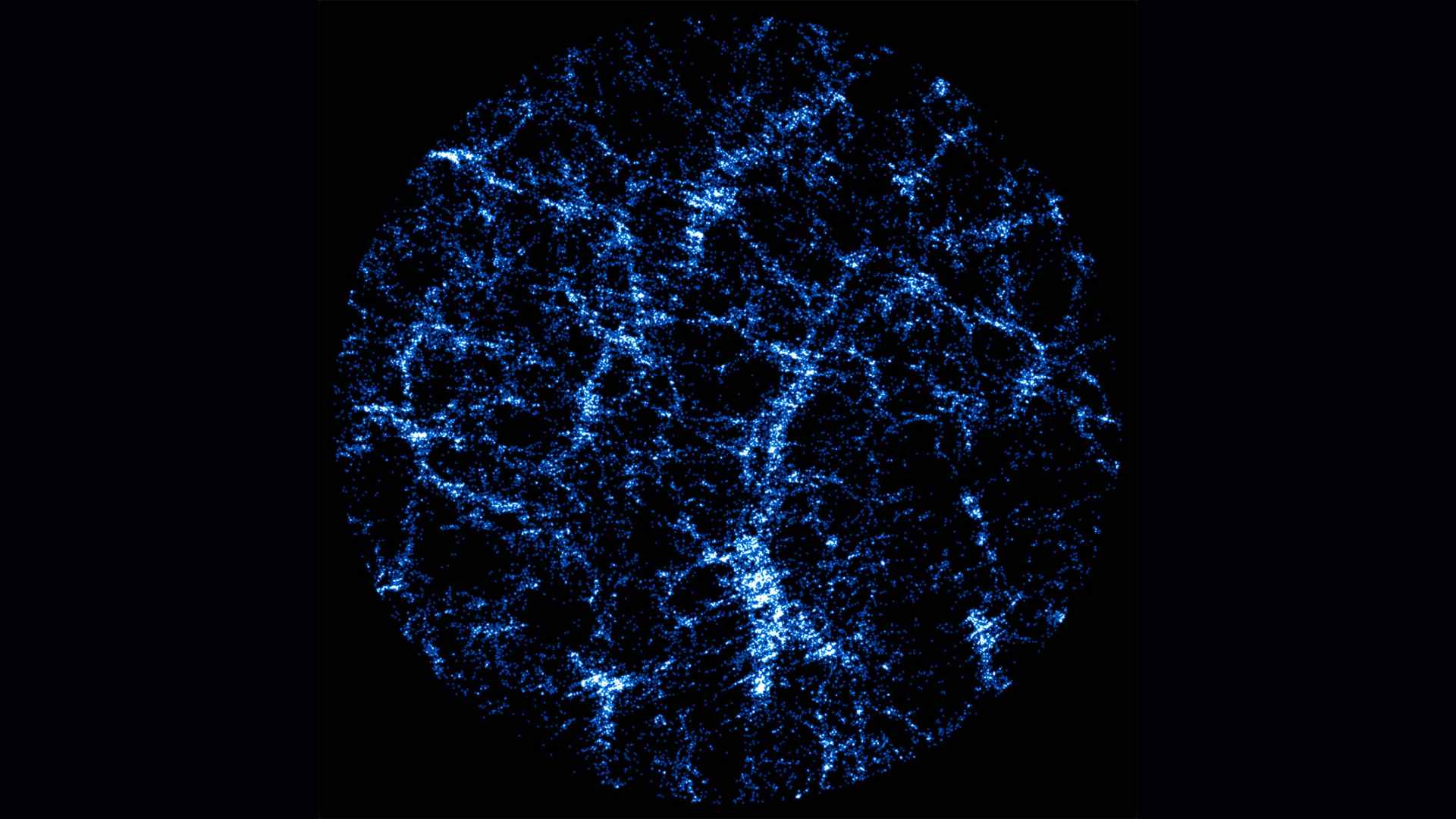
One slice of a vast 3D map of galaxies produced by the Dark Energy Spectroscopic Instrument.
Credit: Francesco Sylos Labini/Enrico Fermi Research Center
24/06/2026 “The universe is unexpectedly stringy, which could unravel the theory of the cosmos.Controversial claim challenges principle of cosmological sameness on which prevailing theory rests”, by Adam Cho in Science:
25/06/2026 “Did two physicists just upend decades of cosmology research? A new study claims that the universe isn’t entirely the same no matter where you look—a radical proposal”, by Joseph Howlett in Scientific American
25/06/2026 “The universe should look the same in all directions at large scales, but DESI data suggest otherwise”, by Kristal Kasal, in physics.org
24/06/2026 “Vast ‘Structures’ In Space Reveal the Universe Isn’t What We Thought”, by Becky Ferreira in 404.
24/06/2026 “Across the Universe, galaxies clump together more than physicists thought they should” in Nature Podcast, 13.57