


the institute

The legacy of Enrico Fermi. The challenges of the future

about us
the organization

research

The Enrico Fermi Research Center - CREF promotes original and high-impact lines of research, based on physical methods, but with a strong interdisciplinary character and in relation to the main problems of the modern knowledge society.

Complexity
Applied Physics
Fundamental Physics
Museum and History of Physics
INFRASTRUCTURES

People

third mission

The CREF was born with a dual soul: a research centre and a historical museum. Its aim is to preserve and disseminate the memory of Enrico Fermi and to promote the dissemination and communication of scientific culture.

news

Publications, news, press review. For interviews, filming, and press contacts, please write to comunicazione@cref.it

cover_posts_iupap_ 2026

NEWS

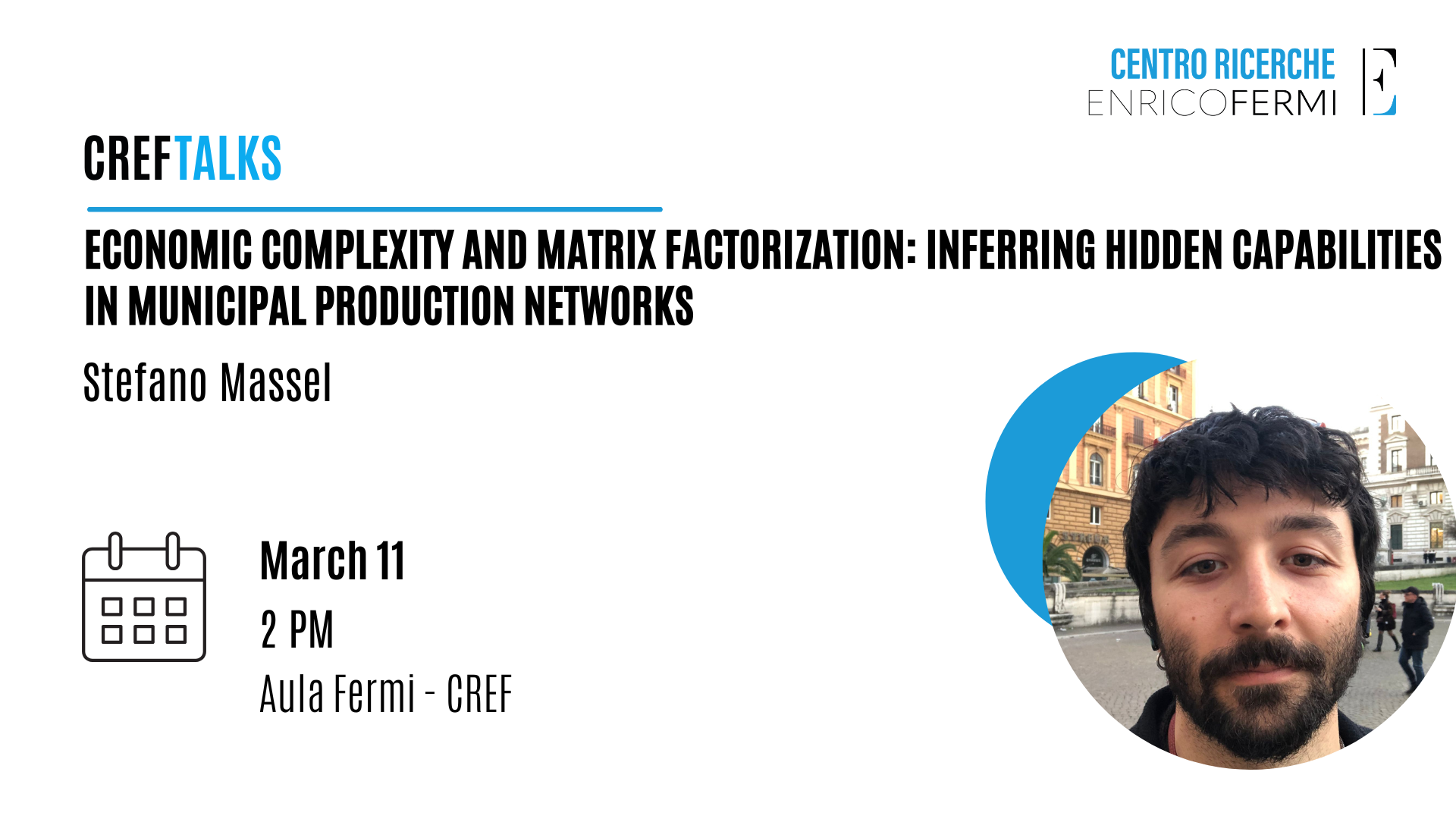
Economic Complexity and Matrix Factorization: Inferring Hidden Capabilities in Municipal Production Networks 

TALK
Economic Complexity and Matrix Factorization: Inferring Hidden Capabilities in Municipal Production Networks
March 11 – 2pm
Aula Fermi
Speaker: Stefano Massel
In Economic Complexity, capabilities represent the hidden endowments that shape regions’ productive structures. While central to theoretical frameworks, empirical approaches to inferring them directly from data remain scarce and largely unexplored. This work helps fill that gap by developing a methodology to extract information about this latent capability layer from observable economic activity.
We employ Italian municipal-level data organized as a binary municipality-activity matrix, where entries encode the presence or absence of economic sectors (classified via ATECO/NACE codes) across municipalities. We approach the problem through the lens of matrix factorization, treating the reconstruction of the municipality-activity matrix as an optimization problem where latent factors correspond to underlying economic capabilities.
Using a mask-and-predict validation framework, we find that five latent components constitute an optimal balance between reconstruction accuracy and model parsimony, achieving accuracies above 80% for both zeros and ones in the original binary matrix. The identified components correlate strongly with observable economic-geographic properties of Italian municipalities, lending empirical meaning to the inferred dimensions.

Integrating Fitness-Complexity metrics into the analysis confirms the consistency of that classification while revealing that its structural skeleton persists even as additional degrees of freedom are introduced. Comparison against null models further demonstrates that the municipality-activity matrix contains sub-structure beyond what Fitness-Complexity alone captures, pointing toward new algorithmic directions.
This work represents an early attempt at capabilities inference on highly disaggregated sub-national data, in an attempt to bridge the gap between theoretical economic complexity frameworks and measurable productive structures at the municipal level.
share on: