

Rome, March 17, 2026. A new project in collaboration with the PhD program in Heritage Science at Sapienza...

The Enrico Fermi Research Center - CREF promotes original and high-impact lines of research, based on physical methods, but with a strong interdisciplinary character and in relation to the main problems of the modern knowledge society.
The CREF was born with a dual soul: a research centre and a historical museum. Its aim is to preserve and disseminate the memory of Enrico Fermi and to promote the dissemination and communication of scientific culture.
Publications, news, press review. For interviews, filming, and press contacts, please write to comunicazione@cref.it
Rome, March 17, 2026. A new project in collaboration with the PhD program in Heritage Science at Sapienza University applies advanced scientific methodologies to reconstruct the dynamics of the destruction of ancient sculptural heritage.
The Enrico Fermi Research Center (CREF) will host researcher Emanuela Bruno for the next six months. She is enrolled in the National PhD Program in Heritage Science at the Department of Antiquities at Sapienza University of Rome. The project, developed through a research agreement with the Physics for Cultural Heritage Laboratory of CREF, coordinated by Dr. Giulia Festa, aims to decipher the traces of iconoclasm dating back to Late Antiquity (4th–6th centuries AD) found on marble statues in Rome and Ostia.
Between the 4th and 6th centuries AD, during an era marked by profound and radical religious and cultural changes, countless classical sculptures suffered intentional damage. Today, what might have seemed like simple “mutilations” in the past represent invaluable material evidence for scholars to understand the transformation processes of late antique society. The objective of the research is precisely to map and interpret these destructive gestures.
The investigations are being conducted on a large corpus of sculptures preserved at the National Roman Museum across its venues at Palazzo Altemps, Palazzo Massimo, and the Baths of Diocletian, as well as at the Archaeological Park of Ostia Antica. The goal is to systematically document and analyze the fracture traces and impact marks present on the marble surfaces.
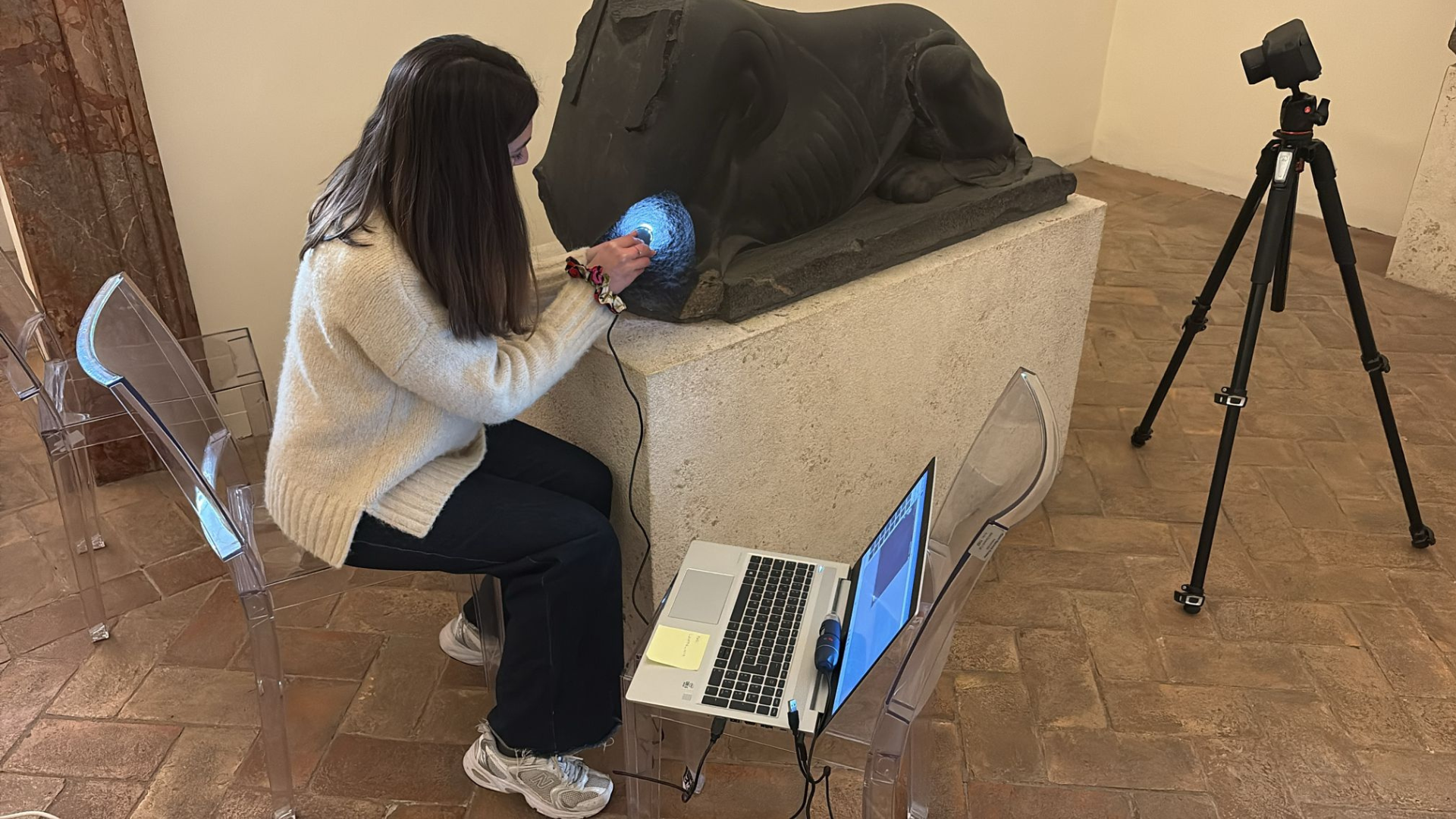
The research integrates various documentation and analysis techniques. These include macrophotography, grazing-light microphotography, petrographic observations for identifying the type of marble using a digital optical microscope, and three-dimensional surveys via photogrammetry.
These methodologies allow researchers to record the morphological characteristics of fractures and impact marks with great precision, providing a detailed dataset of the intentional alterations present on the statues.
Once the data collection phase is complete, the information will be processed using machine learning to obtain quantitative results. This approach will allow the identification of recurring destructive patterns, contributing to the comparative study of the methods used to damage statues as a result of iconoclastic behavior.
The project also includes an experimental archaeology workshop, during which the response of the marble material to different types of blows will be observed, based on the traces recognized on the ancient sculptures. The goal is to compare the experimental data with archaeological evidence to better understand the dynamics of iconoclastic gestures and the techniques employed.
Through the integration of archaeology and quantitative methods, the collaboration aims to develop a new interpretative methodology for studying the cultural transformations of antiquity and for a more profound understanding of the material traces left by iconoclastic phenomena on ancient sculptural heritage.