
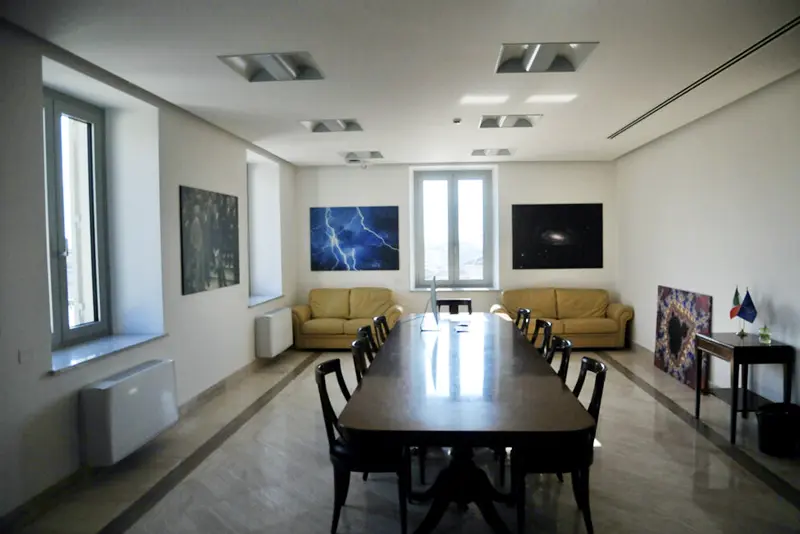

On 20 February, in the Fermi Hall of the Institute, the CREF project update presentations were held for...


The Enrico Fermi Research Center - CREF promotes original and high-impact lines of research, based on physical methods, but with a strong interdisciplinary character and in relation to the main problems of the modern knowledge society.
The CREF was born with a dual soul: a research centre and a historical museum. Its aim is to preserve and disseminate the memory of Enrico Fermi and to promote the dissemination and communication of scientific culture.
Publications, news, press review. For interviews, filming, and press contacts, please write to comunicazione@cref.it
Quantum Phenomena in Superconducting Circuits: The Work of Clarke, Devoret, and Martinis, Nobel Laureates in Physics 2025, Lays the Foundation for the Quantum Computer
In the International Year of Quantum Mechanics and Technology, the Nobel Prize in Physics has been awarded to three physicists: John Clarke, Michel H. Devoret, and John M. Martinis, “for the discovery of macroscopic quantum tunnelling and energy quantisation in an electrical circuit.”
One of the greatest mysteries of quantum mechanics lies in the limits of its applicability. While we know that at the atomic and subatomic scale an object can exist in a superposition of infinite self-realisations, the same does not occur in observable, macroscopic reality. The superposition principle, as well as the tunnelling effect and the quantisation of energy levels, belong to the microscopic world. Yet these “quantum quirks” seem to vanish when we observe macroscopic objects, which appear localised, non-quantised, and certainly do not pass through walls at our scale.
Unless the environment destroys the quantum behaviour by interacting with the microscopic object—a phenomenon we call environmental decoherence—the fundamental nature (and its mathematical explanation) of the transition from the quantum world to the classical world (our macroscopic world) remains a mystery.
In this context, the three physicists experimentally demonstrated that two typically quantum behaviors—the tunneling effect and energy quantization—can be observed in a system composed of a vast number of electrons acting collectively, specifically within a visible electronic circuit. To achieve this, they used superconducting circuits with Josephson junctions.
The discovery by the three Nobel laureates has enabled the creation of electrical circuits that behave like quantum objects, known as “qubits,” thereby paving the way for superconducting-based quantum computer technology.
Thanks to their groundbreaking work, John Clarke (University of California, Berkeley), Michel H. Devoret (Yale School of Engineering and Applied Science), and John M. Martinis (University of California, Santa Barbara) are recognized as the founding fathers of this technology, which aims to exploit the laws of quantum mechanics to perform complex calculations potentially much faster than classical computers.