
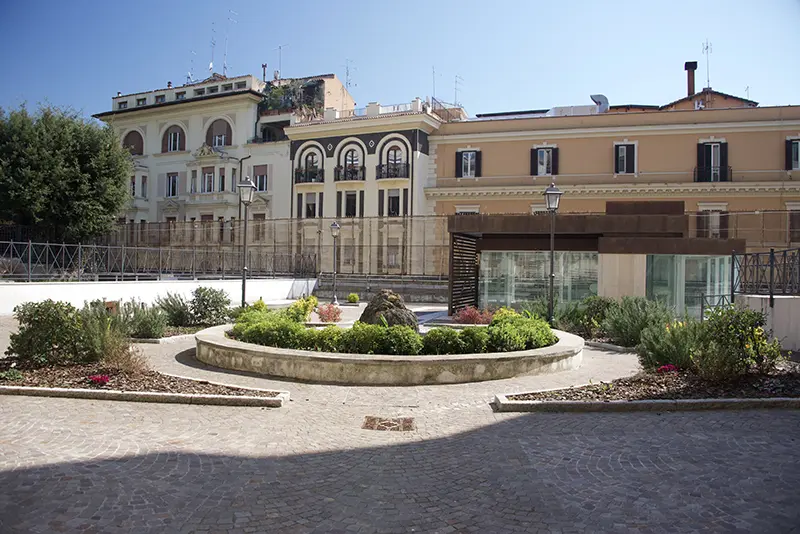
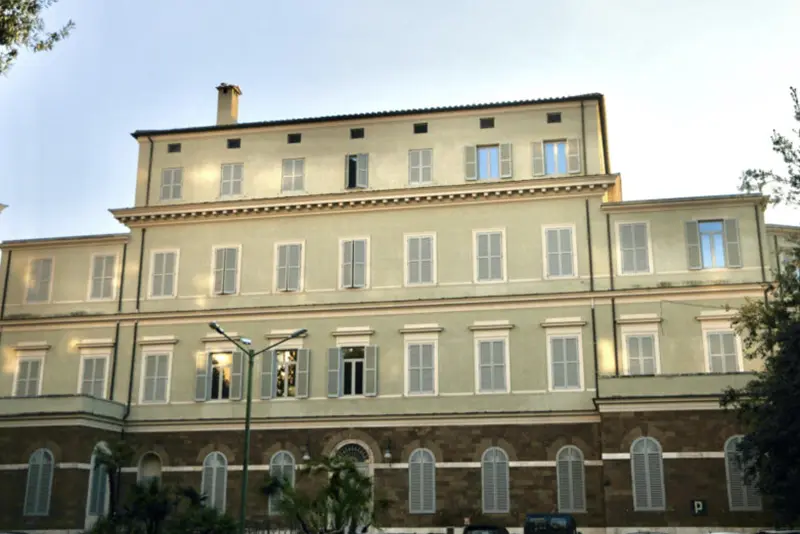
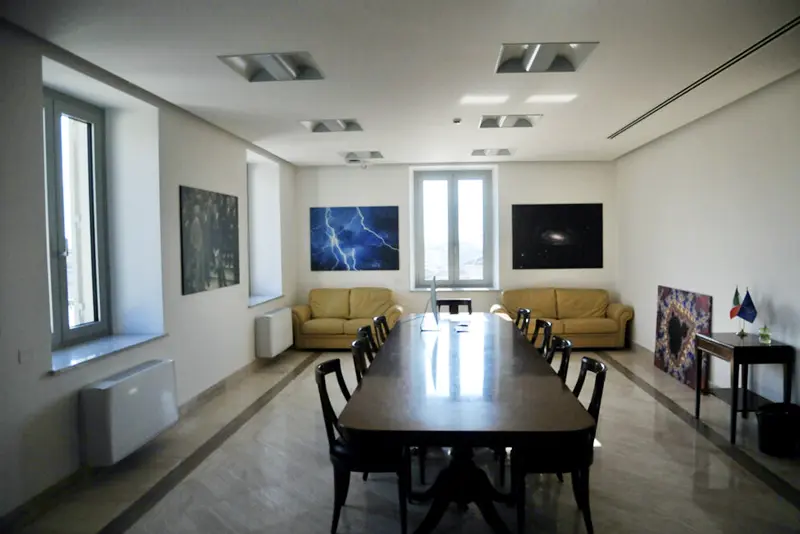


On March 12, 2026, the Kickoff Meeting for the TRHYB project was held at the Enrico Fermi Research Center...

The Enrico Fermi Research Center - CREF promotes original and high-impact lines of research, based on physical methods, but with a strong interdisciplinary character and in relation to the main problems of the modern knowledge society.
The CREF was born with a dual soul: a research centre and a historical museum. Its aim is to preserve and disseminate the memory of Enrico Fermi and to promote the dissemination and communication of scientific culture.
Publications, news, press review. For interviews, filming, and press contacts, please write to comunicazione@cref.it
The transition towards a green and digital economy—often termed the “Twin Transition”—is the defining challenge of our time. But how do we ensure this shift does not exacerbate existing inequalities? How do we move from ambitious rhetoric to effective, evidence-based policy?
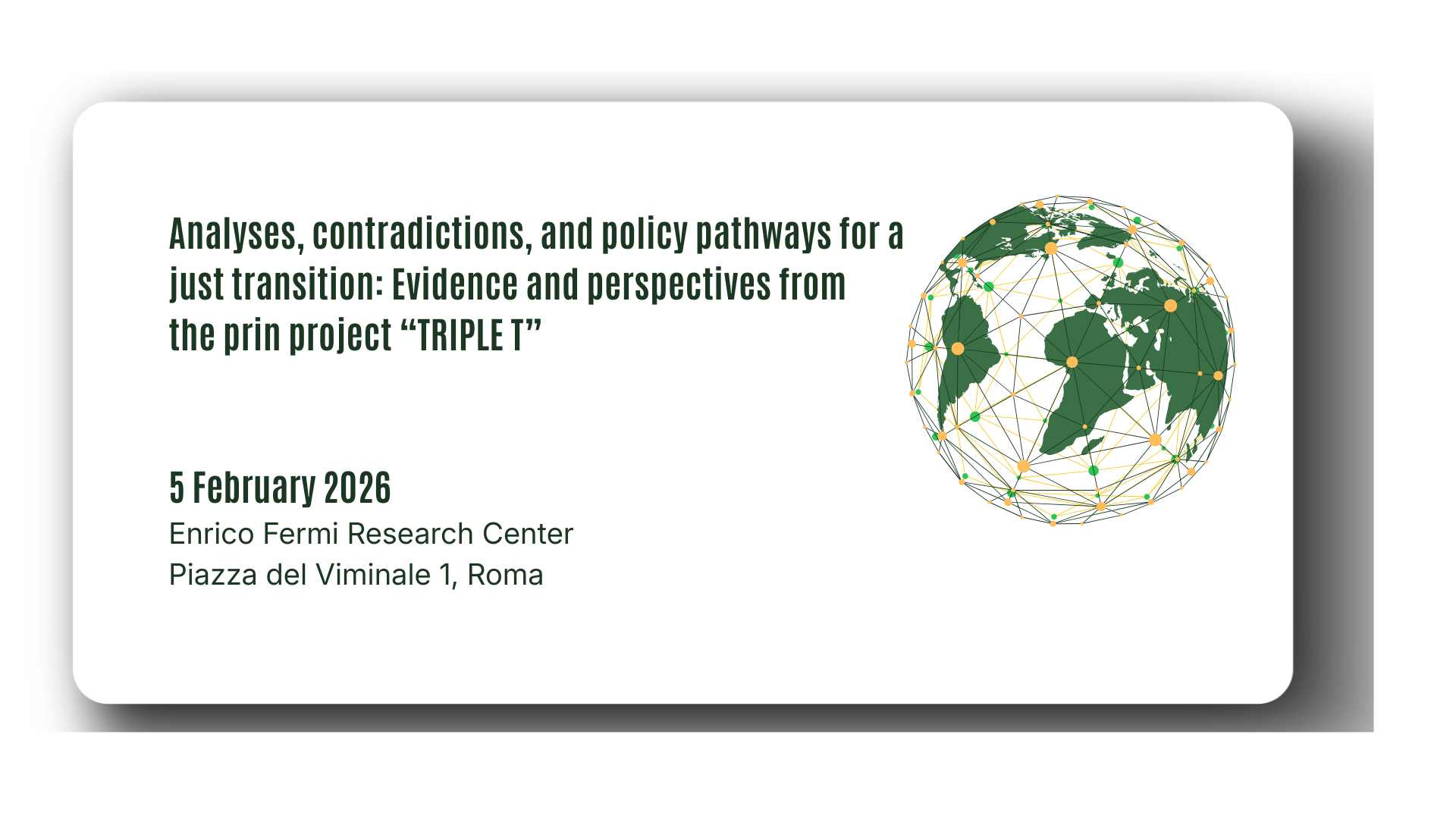
These were the central questions addressed during the final workshop of the PRIN 2022 PNRR Project “TRIPLE T” (Tackling a just Twin Transition: a complexity approach to the geography of capabilities, labour markets and inequalities – CUP F53D23010800001).
The event, hosted at Centro Ricerche Enrico Fermi on February 5th, brought together researchers, policymakers, and civil society representatives to discuss the contradictions inherent in this transformation and to propose a roadmap for a truly “just” transition.
The “TRIPLE T” project adopts a complexity approach. By mapping the “geography of capabilities,” the project highlights how different regions and sectors possess vastly different starting points. A policy that works for a tech hub may fail in an industrial heartland. The workshop underscored that understanding these nonlinear dynamics is essential to preventing the widening gap between the “winners” and “losers” of the new economy.
The first part of the workshop was dedicated to presenting and discussing the research outcomes. In particular, the impact of the green transition and AI on the labour market, energy policy, and the environmental conflicts that can arise, and the role of Critical Raw Materials in technology development.
Anabel Marín (Institute of Development Studies, University of Brighton) addressed these “Contradictions and civic power in the green transition,” exploring how civic agency can influence the direction of change.
Complementing this, Giovanni Dosi (Scuola Superiore Sant’Anna) focused on “Industrial policies for global commons,” arguing for robust frameworks that treat sustainability not just as a market opportunity, but as a shared global responsibility.
A key theme of the workshop was the recognition that a successful transition cannot be imposed solely from the top down. Voices from local governance, such as Amedeo Ciaccheri (President of Municipality Roma VIII), and advocacy groups like Legambiente and the Forum Disuguaglianze e Diversità (represented by Vittorio Cogliati Dezza), emphasized that policy actions must be rooted in the needs of communities. The discussion, enriched by perspectives from journalism (Caterina Orsenigo, Domani) and the energy cooperative sector (Gianluca Ruggieri, ènostra), underscored that civic engagement is not an optional add-on, but a fundamental driver of a fair transition.